
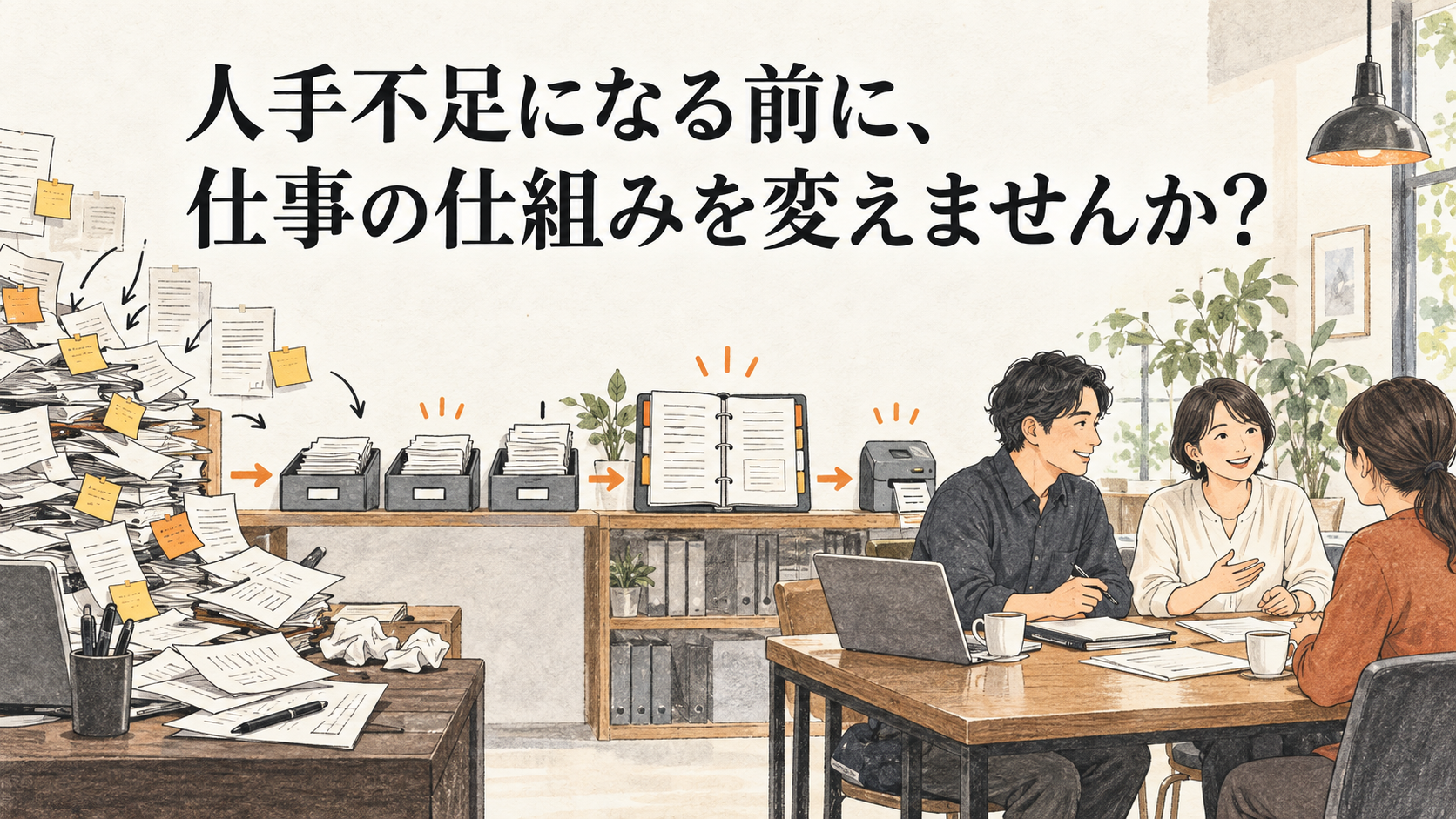
01Hiring alone may not solve the problem
Yahoo! News carried an article reporting a record number of labor shortage-related bankruptcies in the first half of the fiscal year. It covered a survey published by Tokyo Shoko Research on October 5, 2026.
Translation from the Japanese source: “Labor shortage-related bankruptcies reached a record 240 cases, up 17.0% from the same period a year earlier.”
Source: Tokyo Shoko Research — TSR Data Insight
These figures cover April through September, the first half of fiscal 2026. Of the 240 cases, 130 were associated with rising labor costs. This suggests that businesses are facing growing pressure not only to find staff, but also to afford keeping them.
Recruitment, higher pay and a better working environment all matter. But focusing only on adding staff may cause us to overlook unnecessary work in the day-to-day routine.
Entering the same information repeatedly. Having to ask one particular person before anything can move forward. Reducing this kind of work could help the people already on the team work at a sustainable pace—and make the business better prepared for staffing shortages.
02Look at the work to understand why everyone is busy
Suppose a request arrives by email. Someone copies it into a spreadsheet, then enters it into another system. Each task may be small, but repeating it for every request takes time.
If that process stays the same, adding staff will not remove the duplicate entry. New hires will also need time to learn it. Hiring more people and reducing unnecessary work are worth considering together.
To review the work, start by writing down what takes time. Is it entering information, searching for documents, or waiting for someone to reply? Once the reason is clearer, it becomes easier to see what could change.
Reducing administrative work cannot replace hands-on work or tasks that require qualifications and experience. Recruitment and staffing decisions still matter. The question is whose workload a change can realistically ease.
03Before working faster, could you change the process?
An example in Cybozu Shiki shows how a recruitment team changed its process. The team had checked attendance at company information sessions on paper, copied it into Excel, and then entered it into another system.
They changed this so participants could enter their own attendance information into a form, with that information passed to the system. Instead of entering information faster, they removed the need to copy it over.
You can look at your own work in the same way. Are people still producing documents that nobody uses? Is the same information being entered in several places? Start by finding tasks that could be removed or completed just once.
Then document the steps, guidance for decisions, and who to ask for help so that another person can take over. Do not stop at writing it down: having someone else try the task can reveal what the instructions are missing.
Consider AI and automation alongside this review of the work. Automation can route requests and send notifications according to set rules. AI can help organize text and prepare drafts. When the task you are delegating is clear, it is also easier to decide what a person needs to check.
04What could this look like for customer inquiries?
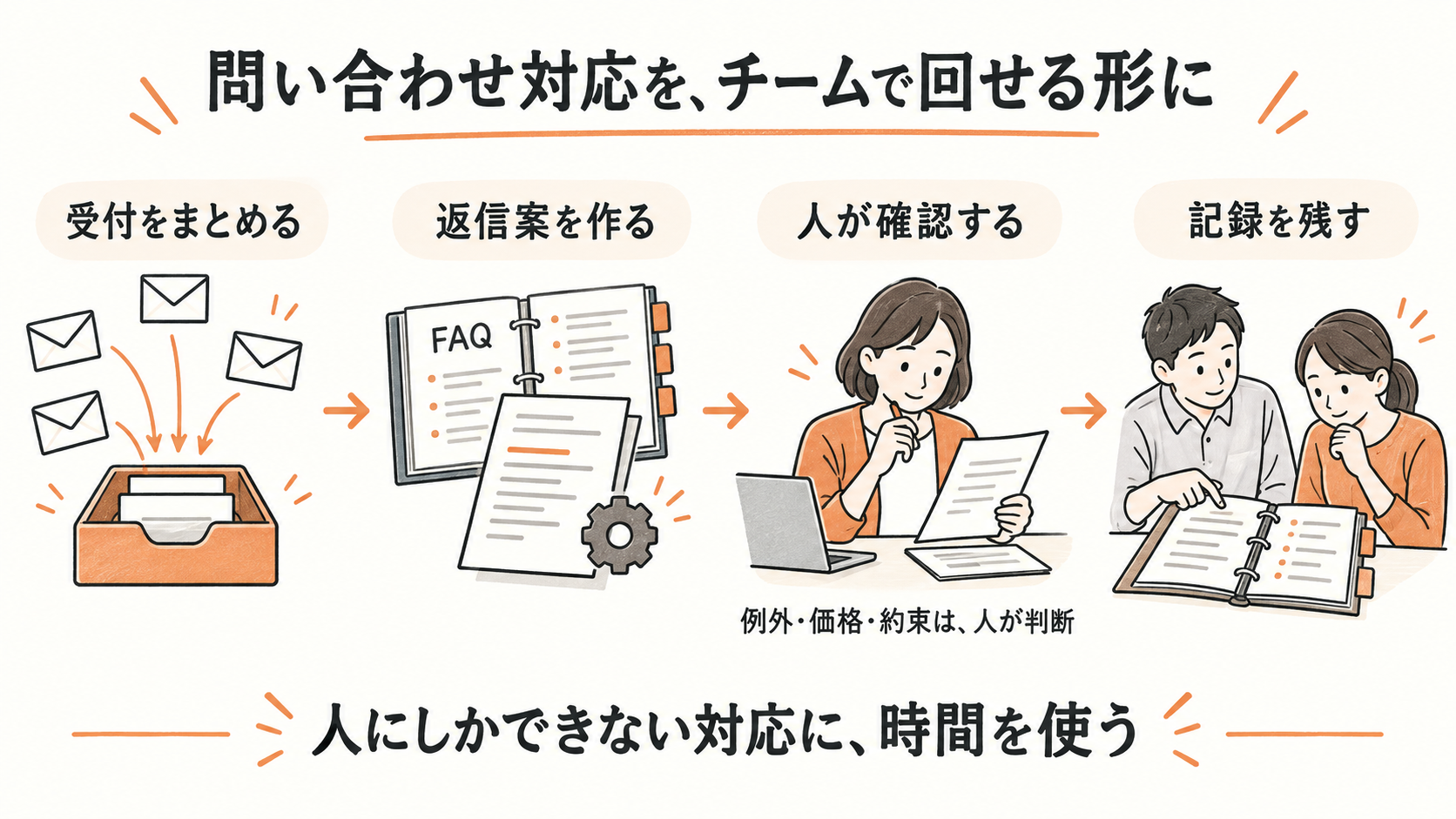
An inquiry arrives in one employee's inbox. That person searches for previous answers and replies. Nobody else can tell whether a response has been sent. How could a process like this change?
First, put the inquiries and their status somewhere the team can see them. If everyone can tell who is handling a request and what is being checked, another person can pick it up when the usual contact is away.
For common questions, AI could prepare a draft response using current product information and FAQs. The person handling the inquiry would check the draft before sending it, then record the answer and the reasoning behind the decision.
05Start with one task you repeat each week
Finding time to review work is not easy when everyone is busy. Adding improvement work on top of the usual workload can simply increase the burden. Start with one task that repeats each week, and decide who will review it and how much time they will have.
Write out the steps from the arrival of a request to its completion. Look for duplicate entry and points where work waits for someone to check it. Change one part of the process and try it.
After the trial, compare not only time spent, but also how often corrections are needed and how many requests are still waiting for a reply. An AI draft may be quick to produce, but if review and corrections take a long time, the team's workload has not necessarily improved.
When deciding whether to continue, include tool fees and the time needed to adjust settings and teach people how to use the tools. Any time freed up might go toward customers or training new staff. Making it easier for people to take time off is also a reason to change how work gets done.
06Make a start before staffing becomes a problem
Keep recruiting while reviewing how the current work gets done. Aim for a situation where someone else can pick up a task when its usual owner is away, and new hires can take on work. Gradually building that kind of team is one way to prepare for staffing shortages.
Think of a task you repeat every week, or a job that seems unable to move forward without one particular person. Where does the time go? What might be possible to change?
At Deltalyze, we listen to how your work currently flows and help you consider tasks you could reduce, ways to hand work over, and where AI might help. You do not need to know exactly what to change before getting in touch. Tell us what has been bothering you in your everyday work.
07Sources and context
Tokyo Shoko Research's survey draws from business bankruptcies across Japan with liabilities of at least JPY 10 million. It covers cases associated with recruitment difficulties, employee departures and rising labor costs. Cases involving a lack of successors are excluded.
The work improvements discussed in this article are the author's proposals. The survey does not provide evidence that AI prevents bankruptcy.
The cover image and the illustration in the article were generated with AI.
SOURCES
Sources and references
- Yahoo! News (original publisher: Tokyo Shoko Research)「Labor shortage-related bankruptcies reach a first-half record」(2026-10-05)
- Tokyo Shoko Research — TSR Data Insight「Labor shortage-related bankruptcy trends in the first half of fiscal 2026 (April–September)」(2026-10-05)
- Cybozu Shiki「How a recruitment team changed its work process after relying on overtime」
KEY TAKEAWAYS
What to carry into implementation
- Review unnecessary work alongside recruitment
- Look for tasks to remove and better ways to hand work over before trying to work faster
- Include AI review and corrections when checking whether the workload has actually decreased
FAQ
Frequently asked questions
Can AI solve a staffing shortage?
What AI can do depends on the task. Administrative automation cannot replace hands-on work or tasks that require qualifications. Consider which tasks could become less time-consuming alongside recruitment and staffing decisions.
Where should we start?
Choose one task you repeat every week whose steps you can explain. Write out the process from receiving a request to completing it, and look for duplicate entry or time spent waiting for a check.