

01What Was Announced
On September 29, 2026, OpenAI made over 20 announcements at DevDay 2026. These included the new model GPT-6.1 Sol and the always-on agent Dots. The announcements spanned four areas—ChatGPT, Codex, models, and new ways of working—and are summarized in the official recap article.
Dots is an always-on agent that keeps working without human intervention once a task is assigned. This differs fundamentally from the conventional ChatGPT usage pattern of "it only acts when a person types a prompt."
02Pricing and Availability
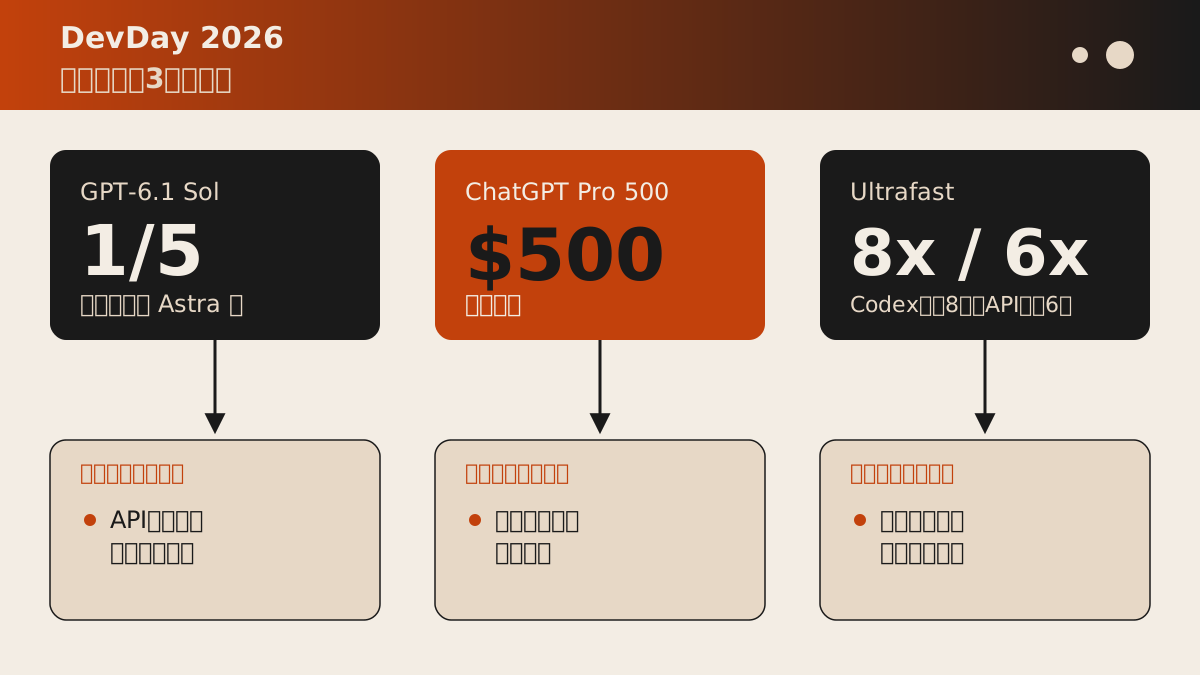
The biggest pricing change is that the input/output token price of the new model GPT-6.1 Sol has dropped to 1/5 of the standard price of the previous model, Astra. GPT-6.1 Sol is available across the API, Plus, Pro, Business, Enterprise, and Edu plans.
A new paid tier called Ultrafast, prioritizing processing speed, was also introduced. Official performance figures show up to 8x faster (300 tok/s) when used with Codex, and up to 6x faster when used via the API. For individuals, a new Pro 500 plan was also introduced at $500/month, offering 25x the usage quota of Plus, with the Ultrafast tier included in that quota. These are all figures as of the official announcement, and local pricing reflecting Japan's rollout timing and exchange rates needs to be confirmed separately on the official page.
03Practical Business Use Cases
Always-on agents like Dots are thought to be well-suited to tasks requiring continuous monitoring. In accounting—though unconfirmed—one could imagine assigning tasks such as periodically checking invoice receipt status or reconciling payments. In sales, a conceivable use would be having the agent handle background research for proposals or regular competitive intelligence gathering.
In HR, organizing inquiry response logs, and in planning departments, ongoing monitoring of market trends—the trend of handing over tasks that "a person has to remember to do every time" to agents is expected to spread. However, these are all speculative examples based on anticipated use cases, and OpenAI has not officially published industry-specific case studies.
For the design thinking behind embedding generative AI into business workflows, see Building Next-Generation In-House Workflows with Generative AI. The conditions for successfully advancing field-led AX (AI Transformation) are summarized in Three Conditions for Successful Field-Led AX.
When applying a mechanism like an always-on agent to accounting work, how previously person-dependent checks change also becomes a point of discussion. Resolving Key-Person Dependency in Accounting: A Roadmap for Strengthening Controls and Adopting AI Agents covers how to pursue both governance and agent adoption together.
- Accounting: periodic execution of invoice reconciliation and payment matching (unconfirmed, speculative)
- Sales: periodic collection of research materials for proposal preparation (speculative)
- HR: organizing and summarizing inquiry history (speculative)
- Planning: ongoing monitoring of market trends and competitive information (speculative)
04What to Verify Regarding Governance and Data Handling
When considering adopting the Agents API, including Dots, as CDO Magazine reports, the rollout of Dots has been raised as a data governance issue. When considering adoption at your own company, it seems advisable to individually verify whether the storage region aligns with your existing data management policy under your Enterprise contract.
Another point worth checking is that, as reported, the Enterprise version requires explicit activation by an administrator. Though unconfirmed, given the always-on nature of the agent, audit logs of who assigned which task under what authority are likely to matter more than with conventional ChatGPT, where a person operates it each time.
A discussion of internal control issues in the accounting domain is also covered in Points to Organize Around Controls Before Using AI in Accounting. There are also factors beyond governance behind why operational documents created in the field fall out of use, which is covered in Why Do Documents Created to Address Key-Person Dependency Go Unused?.
- Data residency: it seems advisable to individually verify whether the storage region aligns with the Enterprise contract's data management policy (a recommendation based on CDO Magazine's reporting, including unconfirmed points)
- Enterprise version activation: explicit configuration by an administrator is required
- Audit logs: confirm how task assignments are recorded before adoption (unconfirmed, includes speculation)
05Your Next Move
This week, identify from your company's list of operations which tasks "require continuous monitoring or periodic execution," and check one by one whether the data residency of the data handled in each aligns with your existing data management policy under your Enterprise contract. The decision on whether to use Dots or the Agents API should be made by working backward from the sensitivity of the data handled, not from the appeal of speed or price.
Lower prices and faster processing are welcome changes, but adoption should not proceed while skipping governance checks. The prompt below can be used as-is to identify candidate tasks within your operations list for delegation to an always-on agent.
There are also cases where the cost-reduction estimate itself fails to gain internal approval. How to present such estimates is covered in How to Fix Cost-Reduction Estimates That Get Shot Down by "So, How Much?"—worth checking alongside this article. If you're considering AI adoption in field operations such as manufacturing, Shifting to an AI-Accompanied Operations Model in Manufacturing may also be a useful reference.
Below is a list of tasks handled by my department.

[Paste a bulleted list of task names, frequency, and the type of data handled here. Example: Invoice reconciliation, daily, counterparty name and amount]

From this list, extract tasks that meet the following conditions.
1. It is a recurring task that a person has to remember to execute each time
2. Most of the judgment involved can be done mechanically according to past standards or rules
3. The data handled would not cause operational impact if delegated, per our data management policy

For each extracted task, rate the risk of delegating it (data sensitivity, scope of impact if an error occurs) on a 3-level scale (High/Medium/Low), and add a one-sentence reason.
Replace the content inside [ ] with your company's own list of operations. The output is material for deciding whether delegation is appropriate; the final decision should always be made by a person.
SOURCES
Sources and references
- OpenAI「DevDay 2026 Recap」(2026-09-29)
- RuntimeWire「Everything OpenAI announced at the DevDay 2026 keynote」(2026-09-29)
- CNBC「OpenAI DevDay recap: AI lab rolls out Dots agents, Altman and Friar comment on IPO」(2026-09-29)
- CDO Magazine「OpenAI Launches Dots, Raising New Data Governance Questions」(2026-09-29)
- 9to5Google「OpenAI launches Dots, new 'always-on agents' you can assign tasks to」(2026-09-29)
KEY TAKEAWAYS
What to carry into implementation
- DevDay 2026 featured over 20 announcements, including the new model GPT-6.1 Sol and the always-on agent Dots
- GPT-6.1 Sol is priced at 1/5 of Astra, the Ultrafast tier is up to 8x faster, and Pro 500 costs $500/month with 25x the usage quota
- Dots seems well-suited to tasks requiring continuous monitoring, but concrete use cases remain speculative for now
- Before adoption, be sure to verify data residency alignment and administrator permissions for the Enterprise version
FAQ
Frequently asked questions
What is Dots, announced at DevDay 2026?
It is an always-on agent that keeps working without human intervention once a task is assigned.
Will GPT-6.1 Sol be available in Japan?
It has been officially announced as available across the API, Plus, Pro, Business, Enterprise, and Edu plans. The rollout timing and local pricing for Japan need to be confirmed on the official page.
What are the minimum things to check before adopting Dots?
Two things: whether data residency aligns with the existing data management policy under your Enterprise contract, and the fact that the Enterprise version requires explicit activation by an administrator.