

01What Was Announced
On September 30, 2026, California announced that the governor had signed a law prohibiting AI from making significant employment decisions on its own. The bill was introduced by California State Senator Jerry McNerney (SD05), and is officially named "SB 947," commonly known as the "No Robo Bosses Act of 2026."
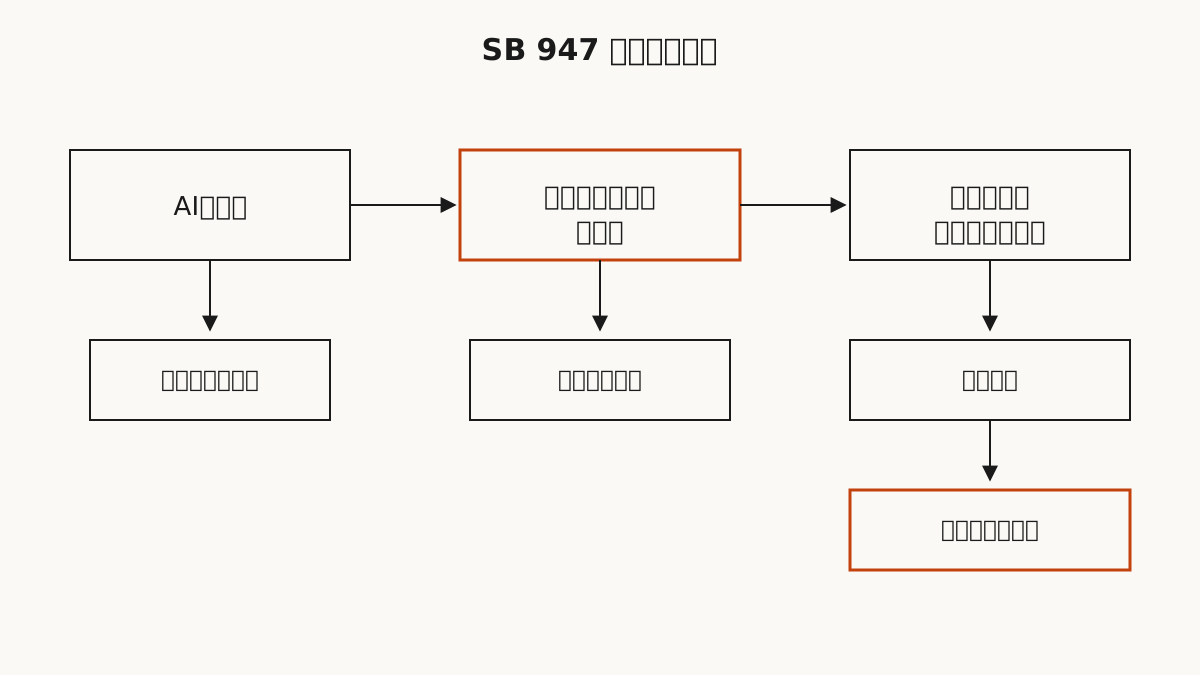
The law bars employers from relying solely on AI to fire or discipline workers, and requires a human reviewer to corroborate decisions that rely primarily on AI, using additional information such as managerial evaluations, peer reviews, and personnel files, according to CNBC. Affected employees must also receive written notice that AI was primarily used, a description of the employee data used, and a human point of contact who can explain the decision.
This law has a backstory. In October 2025, Governor Newsom had once vetoed a nearly identical predecessor bill, "SB 7." The bill was reintroduced in February 2026, and this time the governor signed it.
02Effective Date and Penalties
The first things companies need to note are the effective date and the penalties for violations.
The law takes effect on July 1, 2027 (Source: Bloomberg Law). By then, companies need to build human review steps and written notification mechanisms into their AI-driven employment decision processes.
A bill-stage analysis (Crowell & Moring, February 2026) put the civil penalty at $500 per violation, enforced by the Labor Commissioner or prosecutors, with possible punitive damages and attorney's fees. The amount in the enacted text should be confirmed before the law takes effect.
03Where This Applies in Practice
While this law directly targets terminations and discipline, its impact is likely to extend to the broader operational design of HR evaluation. Although unconfirmed, Japanese companies with U.S. subsidiaries may find themselves reviewing their group-wide HR evaluation AI policies, even without a California presence.
Looking at specific operations, the first area is employee performance evaluation. If a company uses a system where AI calculates scores, it needs to change its operation so that pay raises or contract renewals are not automatically decided based solely on that score. The second is attendance and productivity monitoring tools. When AI detects an anomaly, the design should allow AI to propose disciplinary action, but require a human to make the final execution decision.
The third is recruitment screening. While this law primarily targets termination and discipline of current employees, companies using AI screening during hiring would also benefit from proactively establishing similar human review steps to prepare for future regulatory tightening. For the overall design of incorporating generative AI into business workflows, seeBuilding Next-Generation Internal Workflows with Generative AIas well.
04What to Verify in Governance and Data Handling
There are four points to verify. First, whether your workflow clearly designates a human as the final approver for significant employment decisions (termination, demotion, discipline). Even if the design has a human click the approval button, if that person approves without substantively reviewing the content, it may fail to meet this law's requirements.
Second, whether the AI-generated decision material and the human's final decision are stored as separate logs. You need a record-keeping structure that can separately present, during an audit, "what the AI proposed" versus "what the human decided." For internal governance design, this overlaps considerably with the points covered inGovernance Checkpoints to Sort Out Before Using AI in Accounting.
Third, the workflow for written notice to employees. Check whether you already have prepared notification text and delivery channels for significant decisions involving AI. Fourth, permission design. Who can change the settings of AI tools, and whether a change history is retained, is also likely subject to audit. This connects to the issue of poorly documented handover materials tied to specific individuals, a structural problem of operations becoming hollow in practice, as discussed inWhy Do Handover Documents Created to Address Key-Person Dependency Go Unused?.
05Next Steps
What you can do this week is to compile a list of all HR evaluation AI and monitoring tools currently operating in your company, and take inventory of how far AI involvement extends into decisions related to termination and discipline.
Next, map out where human review steps exist within that decision process. Check whether the review step is merely a formality, or whether there are records showing the approver actually reviewed the content.
This law is a California state law, but the concept of human final decision-making and log retention is a governance practice applicable regardless of location. We recommend incorporating these two points as evaluation criteria into your AI usage roadmap from the outset. Relatedly, governance design for AI agent adoption is covered in concrete steps inEliminating Key-Person Dependency in Accounting: A Roadmap for Strengthening Governance and Adopting AI Agentsas well.
- 1. Inventory your tools
List out the AI tools currently in use for HR evaluation, attendance monitoring, and recruitment screening. Create a table with columns for
tool name,target task, anddepartment using it. - 2. Confirm separation of decisions
For each tool, determine whether the AI only produces a
proposal, or whether it automatically carries through to afinal decision. If any process is automated all the way to final decision, redesign it to include a human approval step. - 3. Confirm where logs are stored
Check whether the AI's proposed content and the human's approval record are stored separately, and in a form that
cannot be altered. If they are mixed together in the same log, consider separating them. - 4. Prepare notification text
For significant decisions involving AI, prepare a
written noticetemplate and delivery process for the affected individual.
SOURCES
Sources and references
- California State Senate (Sen. Jerry McNerney, SD05)「Newsom Signs McNerney's No Robo Bosses Act of 2026 Requiring Human Oversight of AI in the Workplace」(2026-09-30)
- CNBC「California Gov. Gavin Newsom bans AI 'robo bosses' in landmark state law, reversing his earlier veto」(2026-09-30)
- Bloomberg Law「New California Law Requires That Humans Decide Firings, Not AI」(2026-09-30)
- Crowell & Moring「California SB 947 ("No Robo Bosses Act")」(2026-02-02)
KEY TAKEAWAYS
What to carry into implementation
- On September 30, 2026, California's governor signed SB 947, banning terminations and discipline decided solely by AI
- The effective date is July 1, 2027; a bill-stage analysis put the civil penalty at $500 per violation
- HR evaluation AI needs to be designed so that 'AI proposals' and 'human decisions' are recorded separately in logs
- Regardless of location, Japanese companies can proactively build human review and log retention into their own AI operating rules
FAQ
Frequently asked questions
Does this law directly apply to Japanese companies?
SB 947 is a California state law. For companies with U.S. subsidiaries, or those planning to standardize HR evaluation AI operations globally going forward, it can serve as a useful reference case for proactively adopting similar governance measures.
Does this only apply to terminations?
According to reports, it covers not only terminations but also other significant employment decisions such as discipline. Routine attendance management or minor work instructions are not expected to be covered, but the detailed boundaries will need to be confirmed through practical guidance issued before the law takes effect.
What should we do before the effective date of July 1, 2027?
We recommend taking inventory of the decision-making processes in your company's HR evaluation AI, and setting up a system to separate AI proposals from human final decisions in your logs. Refer to the steps outlined in this article.