

01What Was Announced
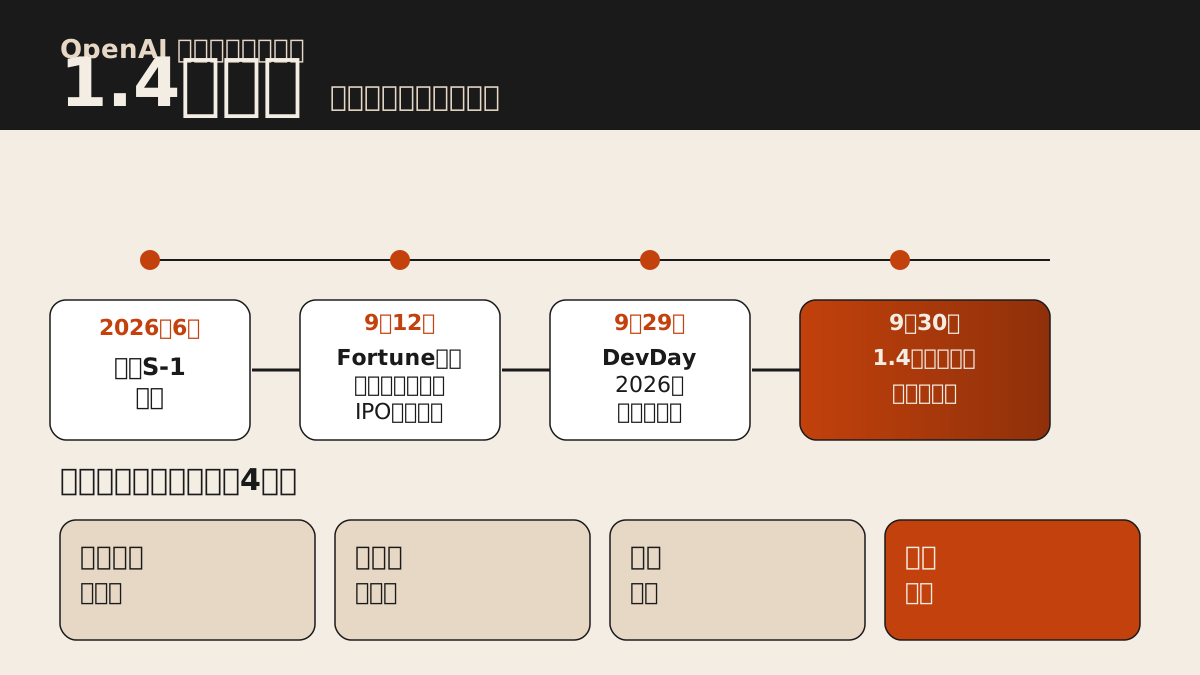
OpenAI CEO Sam Altman said in an exclusive Fortune interview published September 12, 2026, that the company will not IPO within 2026. According to Fortune, the listing will not take place until 2027 at the earliest.
Prior to this statement, Fox Business reported that OpenAI had confidentially filed an S-1 registration statement with the SEC (U.S. Securities and Exchange Commission) back in June 2026. In other words, while IPO preparations continued, management made the call to halt the timeline for execution.
At DevDay 2026 on September 29, the IPO timing remained undetermined, and the company reiterated its stance that being able to make "confident safety claims" is a precondition. No direct announcement has been confirmed on OpenAI's official blog or in press releases—at this point, the primary source is the Fortune interview article. The simultaneous progress of rapid feature rollouts, such as the always-on agent "Dots" unveiled at DevDay 2026, alongside cautious governance decisions, is covered in ourOpenAI DevDay 2026 recap.
02Pricing and Availability
This announcement is not a pricing revision or a new plan—it is a capital policy decision. As such, there is no direct change to enterprise plans or API pricing.
That said, instead of pursuing an IPO, OpenAI is proceeding with private-market fundraising, reportedly at a valuation of around $1.4 trillion with a funding target of at least $30 billion, according to CoinDesk (the talks are reported to be at an early stage, so the figures may change). Annualized revenue had also surpassed $40 billion as of this summer, showing that business growth has not slowed despite the IPO delay.
With fundraising at this scale happening alongside business growth, it's reasonable to expect that plan pricing and availability could change going forward. However, as of this writing, no official pricing changes have been confirmed, and further updates should be watched for. Some vendors also start their top-tier models with limited availability, as covered inGemini 4 Argon Announced: Top-Tier Model Still 'Limited Availability'—What Management Should Watch on Pricing and Use Cases, so understanding each vendor's differing availability policies is a prerequisite for comparison.
03Where This Matters in Practice
Since this announcement isn't a new feature, it doesn't directly change your workflows. However, it is directly relevant as a factor in vendor selection and contract renewal decisions. Whether finance teams are incorporating AI into closing reconciliation work, or sales teams are using AI to draft proposal materials, which vendor fulfills its accountability for safety is likely to become a comparison axis going forward.
For planning teams using AI in market research and competitive analysis, a vendor's own disclosure posture can itself become something worth examining. A management decision to deliberately delay a process involving external audit—an IPO—is worth noting. Since Altman says OpenAI will not rush a listing until it can make confident safety claims, it makes sense to add how a vendor explains its safety to your research checklist.
The same applies when HR teams use AI for handling inquiries: how thoroughly a vendor takes responsibility for explaining safety and data handling directly affects how well issues can be managed after adoption. As more frontline staff use AI, who takes the lead on these verification tasks also becomes a matter of role division. On this point,Three Conditions for Operator-Led AX to Succeedoffers a useful framework for dividing roles between frontline staff and governance owners.
04What to Verify in Governance and Data Handling
The most important thing to check in light of this news is how far major vendors' safety statements actually carry over into your own contracts and terms of service. A management stance that prioritizes proving safety enough to delay an IPO is a separate question from how that translates into actual handling of training data and where logs are stored.
Concretely, you need to verify four points in your contract terms: whether input data is used for further model training, whether data storage is domestic or overseas, how administrator and user permissions are separated, and whether usage history is retained as an audit log. These overlap with the issues covered inPoints to Sort Out on Internal Controls Before Using AI in Accounting.
When incorporating an always-on AI agent into operations, how you design decision-making authority over its operation is a management call. Related points are also covered inOpenAI DevDay 2026 Recap: How Should Management Treat the Always-On Agent 'Dots'?. Even when handing off previously person-dependent verification tasks to AI, designing controls around who gives final approval remains essential. This perspective continues the thinking laid out inReducing Key-Person Dependency in Accounting: A Roadmap for Strengthening Controls and Adopting AI Agents.
05Your Next Step
What you can do this week is open the terms of service for the AI vendors you're already contracted with and check just two things: whether your data is used for training and where it's stored. There's no need to audit everything at once—starting with these two points is the realistic first move.
Cross-reference what you find against the control roadmap covered inReducing Key-Person Dependency in Accounting: A Roadmap for Strengthening Controls and Adopting AI Agentsand the adoption criteria laid out inThree Conditions for Operator-Led AX to Succeed, and you'll start to see where your own AI usage policy is weakest. Rather than how fast a vendor's management moves, having a lens for measuring the depth of their accountability is the most practical step at this stage.
You are responsible for AI usage governance at your company. Read the full terms of service and privacy policy for [vendor name] pasted below, and extract the following four points as a bulleted list.
1. Whether input data is used for further model training, and if so, how to opt out
2. Where data is stored (country, region) and the location of data centers
3. Whether administrator and user permissions are designed as separate roles
4. Whether usage history and operation logs are retained as audit logs, and for how many days
If any of these points cannot be found in the terms, state "Not specified" and do not fill in gaps with guesses.

[Paste the full text of the terms of service here]
Replace [vendor name] and the terms text as needed. If comparing multiple vendors, reusing the same prompt and compiling the results into a side-by-side table makes comparison easier.
SOURCES
Sources and references
- Fortune「Exclusive: Sam Altman addresses AI doomsday fears, IPO timing in new Fortune interview」(2026-09-12)
- Fox Business「Sam Altman says OpenAI won't go public in 2026 amid AI safety concerns」(2026-09-13)
- CoinDesk「OpenAI seeks $30 billion in funding at whopping $1.4 trillion valuation after delaying IPO」(2026-09-30)
- Analytics Insight「OpenAI IPO delayed over AI safety concerns, Sam Altman」(2026-09-30)
KEY TAKEAWAYS
What to carry into implementation
- On September 12, 2026, OpenAI CEO Sam Altman said in a Fortune interview that the company will not IPO within 2026
- At DevDay 2026, the company reiterated that being able to make "confident safety claims" is a precondition, with the IPO timing still undetermined
- While delaying its IPO, OpenAI is simultaneously pursuing a private funding round at a valuation of roughly $1.4 trillion, targeting $30 billion
- What companies adopting AI should watch is not a vendor's feature speed, but its accountability on four points: training data use, data storage location, permission separation, and audit logs
FAQ
Frequently asked questions
When did OpenAI announce it would IPO?
No specific timing has been set. In an exclusive Fortune interview on September 12, 2026, CEO Sam Altman ruled out an IPO within 2026. As of DevDay 2026 on September 29, the timing is still undetermined.
Does the IPO delay affect pricing or service offerings?
As of this writing, no officially announced pricing revisions or plan changes have been confirmed. However, since a funding round at a $1.4 trillion valuation is underway, future changes should be watched closely.
What should companies adopting AI check?
We recommend first checking the terms of service of your contracted AI vendors on four points: whether input data is used for training, where data is stored, whether administrator and user permissions are separated, and whether audit logs are retained.