

01Creating Manuals Alone Does Not Resolve Key-Person Dependency
The reason key-person dependency persists is not the absence of manuals, but the absence of decision criteria. In the same TOKIUM survey, 73.7% of respondents said that manuals defining the decision criteria for journal entries were either "not established" or "insufficient." This figure shows that even companies that have created manuals have not secured reproducibility of judgment.
Journal entry work involves a chain of judgments: selecting account items, determining consumption tax categories, and applying departmental allocation standards. Even when procedures are written into a manual, if exception handling or judgments based on past practice remain, operations grind to a halt the moment a staff member is transferred or resigns. A survey released by Miroku Jyoho Service Co., Ltd. on October 4, 2024 also found that 50.0% of accounting staff at small and medium-sized enterprises cited "key-person dependency in operations" as a workplace concern. Establishing manuals is necessary, but it appears insufficient to resolve dependency in judgment itself.
Key-person dependency has a surface layer—not knowing the operational procedure—and a deeper layer—not knowing the basis or priority behind a judgment. Most companies tackle the former through manual creation, but it is the latter that actually brings operations to a halt. For example, the history of exceptional handling applied to consumption tax classification depending on the counterparty or transaction content is never recorded in a manual; it accumulates only in the memory of the staff member involved. Unless this memory-dependent judgment is surfaced, the same problem will persist no matter how many times the manual is rewritten.
The perspective of separating the deep and surface layers of key-person dependency is common to operational reform outside of accounting as well. The phenomenon in which materials created as a countermeasure against key-person dependency end up unused is widely observed in other departments too. This structure is discussed in detail inWhy Handover Documents Created to Counter Key-Person Dependency Go Unused.
The first step toward resolving key-person dependency is not writing more into the manual, but identifying the decision branch points and quantifying the criteria.
02The Structure of Key-Person Dependency Unique to Mid-Sized Companies
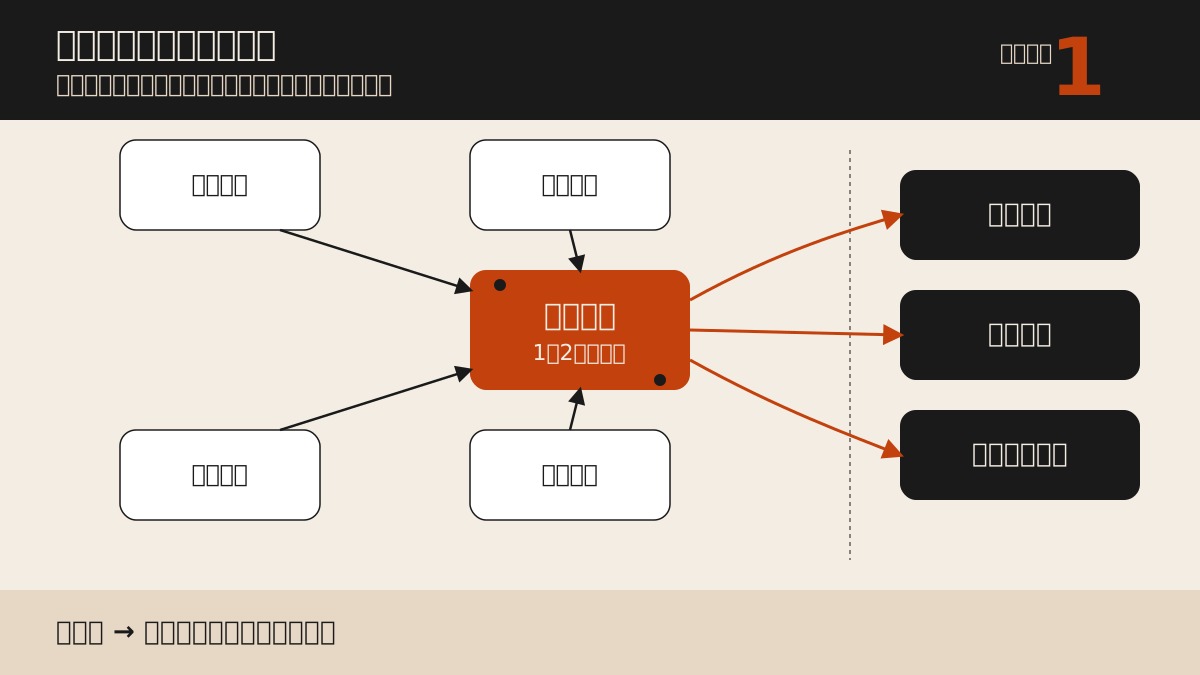
At companies without enough staff to divide into specialized departments, and where the owner does not double as the accountant as in a small business, the middling size of the accounting section amplifies the impact of key-person dependency. This size band creates a structure in which advanced tasks that occur infrequently, such as tax filing and consolidated closing, continue to be handled by one or two long-tenured staff members.
This structure links directly to three risks: delayed closing, an inability to explain matters during a tax audit, and failed handover upon resignation. Many companies respond to key-person dependency by preparing handover documents, but a common pattern is that companies feel satisfied once the document exists, while in actual practice it goes unused. This point—the concrete reasons handover documents become mere formalities—is discussed inWhy Handover Documents Created to Counter Key-Person Dependency Go Unused.
From an internal-control perspective, a state in which judgment is concentrated in a single individual is the kind of segregation-of-duties deficiency that gets flagged in an audit. When an accounting manager explains this structure to management, it is effective to present key-person dependency not as an issue of individual competence but as a control risk. How far the organization of controls should be advanced before AI adoption is addressed separately inPoints to Sort Out Around Controls Before Using AI in Accounting.
Another factor easily overlooked at this size band is seasonal variation in workload. Work concentrates during closing periods and tax filing seasons, while during slower periods the same staff member takes on other duties—meaning that decision criteria used only during busy periods are less likely to be codified into explicit knowledge. The fact that processes occurring only a few times a year tend to depend more heavily on staff memory is important when considering the priority of countermeasures.
This structure of key-person dependency unique to this size band is not limited to the accounting department. Across the organization as a whole, the very structure in which frontline judgment concentrates in specific individuals is a common challenge in advancing operational reform. How to advance reform starting from the frontline is also discussed inThree Conditions for Successful Operator-Led AX.
03Expectations for AI Agents Are High, but Adoption Lags Behind
There is a large gap between the expectations of accounting staff and the reality of adoption. In a survey released by TOKIUM on June 23, 2025, 79.1% of accounting and finance staff expressed hope that AI agents for accounting would resolve labor shortages, while lack of skills (41.0%) and lack of personnel or know-how (35.0%) were cited as factors preventing utilization. This shows that even where expectations exist, most companies have not taken the step of adoption.
This gap likely stems from the absence of in-house specialists capable of selecting and configuring AI agents. When an accounting manager considers AI agent adoption, it helps decision-making to understand in advance how generative AI can be built into existing workflows. A related methodology is discussed inBuilding the Next-Generation In-House Workflow with Generative AI.
A separate survey released by TOKIUM on June 1, 2026 shows the share of accounting staff who say "AI utilization is important." A change in attitude alone will not drive adoption. Given that lack of skills and know-how are cited as barriers to adoption, companies need to decide early on whether to develop in-house specialists or to draw on outside expertise. When referring to adoption cases in other departments, note that the approach to controls differs by industry. The staged approach to adoption in manufacturing is discussed inShifting to an AI-Accompanied Operations Model in Manufacturing, which offers insight into adoption sequencing even for an industry different from accounting.
04The Burden of Approval Work Is Also a Factor in Key-Person Dependency
The work of approving expense claims is prone to depending on the individual judgment of the accounting manager. In a survey released by TOKIUM on September 10, 2025, 97.5% of approvers said they feel "psychological burden" when rejecting expense claims. When the criteria for rejection are not codified, approvers have no choice but to rely on their own personal experience—another form of key-person dependency.
Quantifying the criteria for approval work benefits both the resolution of key-person dependency and the strengthening of controls. By codifying rejection criteria in terms of amount, account item, and the applicant's job title, and letting an AI agent handle the first-pass judgment, both the approver's psychological burden and variability in judgment can be reduced simultaneously. Approval work is an area of key-person dependency that is easily overlooked, and it needs to be reviewed with the same priority as journal entry work.
What makes key-person dependency in approval work particularly troublesome is that the act of rejection itself affects interpersonal relationships. If a claim is rejected while the criteria remain ambiguous, it appears to the applicant as the approver's personal judgment, generating friction between departments. Conversely, by quantifying the criteria and inserting a first-pass judgment by an AI agent, the basis for rejection is presented as a "rule," which can be expected to have the secondary effect of reducing dissatisfaction directed at the individual approver. A survey released by Deloitte Tohmatsu Group on August 28, 2025 found that about 40% of Prime Market-listed companies (at the department-head level or above) are reassigning personnel as a result of generative AI adoption, suggesting that AI utilization is contributing not only to reduced workload but also to a rethinking of staff allocation.
05Resolve Key-Person Dependency Through a Three-Stage Roadmap
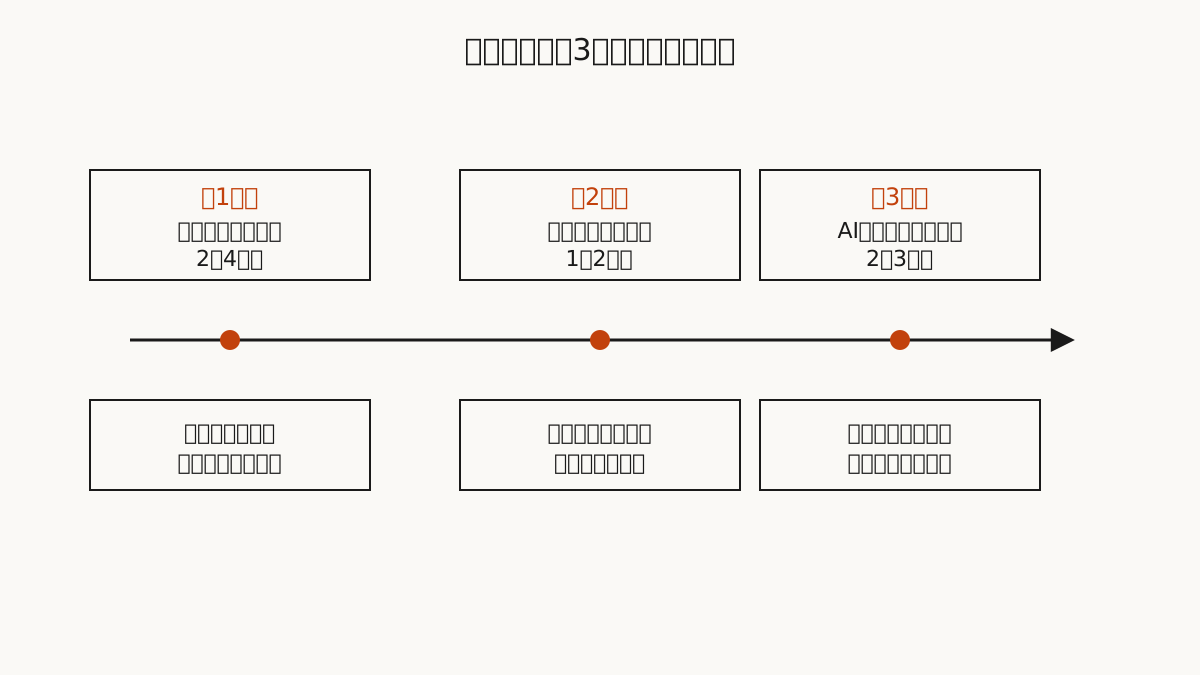
Resolving key-person dependency proceeds in three stages: visualizing decision criteria, reviewing the design of controls, and adopting AI agents. Reversing this order means introducing AI before controls are in place, risking the creation of a new form of key-person dependency in which no one can explain the basis for a judgment. A Keieiken Report by NTT DATA Institute of Management Consulting, reprinted by Jigyo Kōsō Online on August 17, 2026, discusses the relationship between resolving key-person dependency through AI and organizational design.
Trying to compress these three stages in a hurry ends up being counterproductive. If a company skips the visualization of decision criteria and jumps straight into AI agent adoption, there will be no one able to judge whether the AI's determinations are correct, and confirmation ends up concentrating once again on the original one or two people. Not skipping stages, and instead feeding the data obtained at each stage into the design of the next, is the shortest path to raising the execution speed of the roadmap as a whole.
- Stage 1: Visualize Decision Criteria
From a year's worth of journal entry data, tally by staff member the number of cases in which exception handling occurred in selecting account items or determining consumption tax categories. Interview the staff members with the highest counts about the basis for their judgments, and document it in the form of conditional branches.
- Stage 2: Review the Design of Controls
Once decision criteria have been visualized, create a segregation-of-duties chart that distributes approval authority among multiple people according to amount or account item, rather than concentrating it in one person. Decide on a mechanism for recording who approved what and under which criteria, in anticipation of audit requirements.
- Stage 3: Adopt AI Agents
Based on the documented decision criteria, hand the first-pass judgment of journal entries and expense-claim rejections over to an AI agent. Final approval remains with a human; record monthly the number of cases where the AI's determination and the human's judgment diverged, and keep updating the criteria.
06Explaining to Management Requires a Checklist and Numbers
When an accounting manager tries to persuade management, the risk of leaving key-person dependency unaddressed needs to be shown in numbers. A qualitative report that simply says "we have a dependency problem" will not secure budget. Presenting together the fact that 66.1% of journal entry judgments depend on specific individuals, an estimate of how many days closing would be delayed if that person were absent, and the psychological cost implied by the fact that 97.5% of approval work causes psychological burden makes it much easier for management to make an investment decision.
Presentations to management carry even more weight when accompanied by an estimate of the expected reduction in effort. However, a reduction estimate whose basis is left vague is also the kind of material that can instantly lose credibility the moment someone in the meeting asks, "So, how much?" How to build and present such estimates is discussed inHow to Fix Cost-Reduction Estimates That Get Shot Down by 'So, How Much?'.
A checklist for deciding on AI agent adoption can be generated automatically from your own company's accounting data using the prompt below. Paste it into a generative AI tool such as ChatGPT or Claude, along with a summary of the trends in your in-house journal entry data.
You are an internal control consultant for an accounting department. Based on the following information, create a checklist for assessing the key-person dependency risk of the accounting section.

[Company Information]
- Number of employees: [enter number]
- Number of staff in the accounting section: [enter number]
- Number of journal entries processed in the past year: [enter number]
- Share of journal entry decisions requiring exception handling: [enter share, or write "unknown" if not known]
- List of closing tasks handled by only one or two people: [list task names]
- Monthly number of expense-claim rejections: [enter number]

[Requested Output]
1. From the information above, identify the three tasks with the highest key-person dependency risk, and explain the basis for each risk.
2. For each task, list in bullet form the conditional-branch items that should be identified when documenting the decision criteria.
3. Rank the priority of AI agent adoption along two axes: level of risk and ease of implementation.
4. Present the items needed to estimate return on investment (hours saved, risk-avoidance value) for use in materials presented to management.
Use this after entering your own journal entry data and staff numbers. The more actual figures you input, the more precise the resulting checklist will be.
07The Next Step Is to Measure Your Own Dependency Rate
The starting point for resolving key-person dependency is not selecting an AI tool, but measuring your own company's dependency rate. First check, using your own company's data, what percentage of journal entries depend on a specific individual, and how many people's personal experience underpins expense-approval rejection decisions. Company-wide statistics can serve as a benchmark, but the structure of dependency differs by company depending on industry and closing schedule.
It is also worth checking whether your accounting operations are in a state where improvement can be driven from the frontline. The conditions under which frontline-led improvement takes hold are discussed inThree Conditions for Successful Operator-Led AX. Also, when showing management the return on investment from AI agent adoption, whether a reduction estimate carries persuasive weight depends heavily on how it is presented. This point is discussed inHow to Fix Cost-Reduction Estimates That Get Shot Down by 'So, How Much?'.
The closer the distance between data and decision-making, the more clearly efforts to resolve key-person dependency come across to management. Having a mechanism that visualizes journal entry data and approval history in real time, and continuously tracks changes in the dependency rate, is far more persuasive than presenting a one-off survey result. This idea overlaps with what is discussed inThe Instant Connection Between Data and Decision-Making That the Deltalyze Platform Aims For.
Keeping to the order of measure first, fix next is the condition for ensuring that resolving key-person dependency does not end as a one-off initiative.
SOURCES
Sources and references
- TOKIUM Inc.「Survey on Journal Entry Practices」(2026-05-21)
- TOKIUM Inc. (PR TIMES)「65.4% of accounting staff say "AI utilization is important," up 15.6 points in about a year」(2026-06-01)
- TOKIUM Inc.「Survey on AI Agents for Accounting」(2025-06-23)
- TOKIUM Inc.「Survey on Approvers」(2025-09-10)
- Miroku Jyoho Service Co., Ltd. (MJS Tax and Accounting System Research Institute)「Survey on Working Conditions and Practical Challenges of SME Accounting Staff」(2024-10-04)
- Deloitte Tohmatsu Group「Survey on Generative AI Utilization at Prime Market-Listed Companies」(2025-08-28)
- Jigyo Kōsō Online (reprint of NTT DATA Institute of Management Consulting's "Keieiken Report")「The Risk of 'AI-ification' Facing Companies That Resolved Key-Person Dependency Through AI: Organizational Design to Protect Decision-Making Sovereignty」(2026-08-17)
KEY TAKEAWAYS
What to carry into implementation
- 66.1% of respondents say journal entry decisions depend on the experience of a specific individual, and 73.7% say the decision-criteria manual is not established or is insufficient.
- Resolving key-person dependency in three stages—visualizing decision criteria, reviewing control design, and adopting AI agents—prevents the creation of a new form of dependency.
- 97.5% of approvers feel psychological burden when rejecting expense claims, meaning approval work also needs to be reviewed as a target of key-person dependency.
- Explaining the issue to management requires figures based on your own company's data, such as dependency rate and days of closing delay; company-wide statistics should be used only as a benchmark.
FAQ
Frequently asked questions
Can key-person dependency in accounting be resolved simply by creating a manual?
Creating a manual alone will not resolve it. In the TOKIUM survey, 73.7% of respondents said the manual was not established or was insufficient, and it appears that even companies with manuals in place have many cases where reproducibility of judgment is not secured. Identifying the branch points of judgment and quantifying the criteria needs to come first.
Should AI agent adoption come before or after reviewing control design?
It is recommended to complete the review of control design first, then proceed with adoption. Introducing an AI agent before controls are in place risks creating a new form of key-person dependency in which no one can explain the basis for a judgment.
Is there a key-person dependency risk unique to mid-sized companies?
Because such companies lack enough staff to divide into specialized departments, and are not small enough for the owner to double as accountant, there is a structure in which advanced tasks such as tax filing and consolidated closing tend to concentrate in one or two people. At this size band, the risks of delayed closing and failed handover upon resignation both rise at the same time.