
01What Was Announced
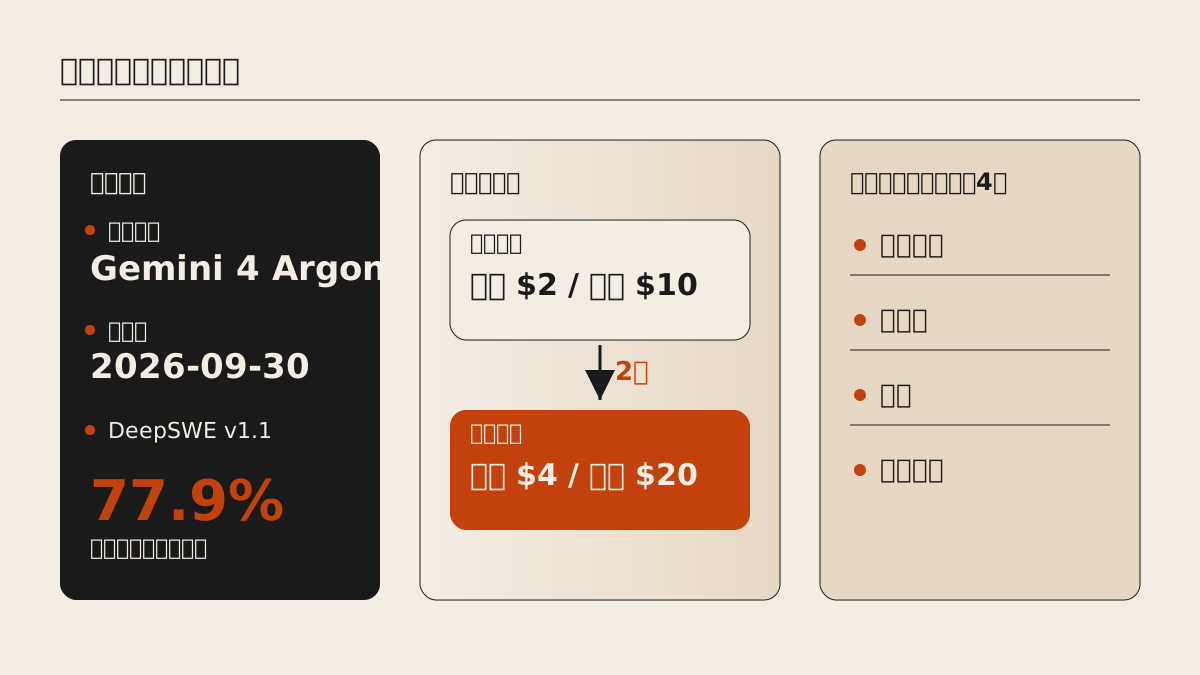
On September 30, 2026, Google DeepMind officially announced Gemini 4 Argon on its blog as the new generation of its frontier model. (Source: Gemini 4 Argon: our next era of frontier intelligence).
On the DeepSWE v1.1 software engineering benchmark, Gemini 4 Argon recorded a new record of 77.9%. (Source: Gemini 4 Argon launches with 1M token output). According to VentureBeat, this result marks Google retaking the benchmark lead over OpenAI and Anthropic. (Source: Google unveils Gemini 4 Argon, retaking benchmark lead).
However, the most important point to note is that early access to the top-tier version is limited to 'trusted cyber defense teams'. Whether and when availability will expand to general developers and enterprises needs to be continuously confirmed through updates on the official blog.
This pattern has repeatedly appeared in past major model launches. Judging adoption timing based solely on benchmark numbers tends to create a gap between what's actually usable and what a company expects to use. In the immediate aftermath of an announcement, information about the terms of availability — who can use it, from when, and for what purpose — is arguably more important for management decisions than the performance figures themselves.
02Pricing and Availability
What matters regarding pricing is that the launch price is temporary and will double afterward. The launch API pricing is set at $2 for input and $10 for output (per million tokens). (Source: Gemini 4 Argon launch pricing).
Reports based on the official announcement indicate that after the launch period, prices will double to $4 for input and $20 for output. (Source: Gemini 4 Argon launch pricing). It's necessary to first calculate whether the estimated monthly cost would still be acceptable even after it doubles.
Meanwhile, the top-tier version has launched in limited release targeted at 'trusted cyber defense teams,' and the timing of broader availability and the details of contract terms need to be continuously confirmed through updates on the official blog. This pricing design carries the risk of locking in a budget based only on initial estimates. A similar issue has been pointed out in the context of verifying cost-reduction estimates — How to Fix Cost-Reduction Estimates That Get Shot Down With 'So, How Much Exactly?' discusses the rework that occurs when numbers are pushed through approval without clearly stating their underlying assumptions.
The official announcement does not specify a clear end date for the launch period. Therefore, current estimates should be made under the assumption that prices will 'double at some point.' Specifically, it would be advisable to estimate monthly token usage, present both the launch-price monthly cost and the standard-price monthly cost to internal stakeholders, and confirm whether the business remains viable under either scenario. Caution is needed, as making decisions before pricing is finalized tends to generate the cost of revisiting those decisions later.
It's also easy to overlook that output tokens are priced higher than input tokens. For use cases that generate large volumes of long-form analysis or reports, focusing cost estimates only on input-side savings can lead to discrepancies with the actual bill. It would be advisable to check unit pricing first for operations that tend to produce large output volumes.
03Where It Can Be Used in Practice
The three areas most likely to be affected are coding, knowledge work, and vulnerability response. The official announcement states that Gemini 4 Argon targets coding, knowledge work, and cyber defense. (Source: Gemini 4 Argon: our next era of frontier intelligence).
In accounting, improved performance in handling long contexts could lead to shorter task times for reconciling journal entries or drafting closing materials. While unconfirmed, the large 1M-token output limit is presumed to be well-suited to processing long documents, such as a batch review of monthly closing materials. Similar effects could likely be expected in sales (drafting proposal documents), HR (drafting inquiry responses), and planning (summarizing market research).
However, all of these are speculation at a stage when general availability remains limited. Before applying this to actual operations, it's necessary to confirm through official sources when the scope of the limited release will expand. In industries like manufacturing, where operations are deeply rooted in on-site work, outcomes depend not just on improved model performance but on operational design. This point is discussed in detail in Shifting to an AI-Accompanied Operating Model in Manufacturing. The preconditions for frontline teams to effectively use such models are also organized in Three Conditions for Successful Operator-Led AX.
Furthermore, as other companies' AI agents, such as Claude, are increasingly integrated into business tools, the nature of such integration directly affects on-site operations. Recent changes unifying chat and agent features are discussed in Claude Cowork and Chat Become One App: 3 Points for Accounting Managers to Check. Whether similar feature integration will progress for Gemini 4 Argon also needs to be continuously confirmed through official announcements.
When considering practical application, it's necessary to think not only about whether the target domains overlap, but also about where in existing workflows the model should be inserted. Caution is needed, as the time-saving effect tends to be limited if a high-performance model is introduced while the handoff of input and output remains a manual process.
04Governance and Data Handling to Verify
Before signing a contract, it's necessary to review the relevant terms of service.
Access design and audit logging are items that can be prepared before the pricing plan is finalized. It would be advisable to define, as internal policy in advance, who can invoke the model for which tasks and where the records of those invocations are kept. This point also overlaps with organizing internal controls in accounting. We've covered this in detail in the previously published article "Points to Organize Around Governance Before Using AI in Accounting
" When incorporating AI into tasks that have become overly dependent on specific individuals, inadequate access design tends to make it difficult to trace records when staff change roles; this point is organized as a roadmap in "Resolving Key-Person Dependency in Accounting: A Roadmap for Strengthening Controls and Adopting AI Agents
" The pitfall of handover documents falling out of use even after being created is also covered in "Why Do Documents Created for Key-Person Risk Mitigation Stop Being Used?
" which is also a useful reference when designing the operation of access controls and audit logging.
At the limited-release stage, contract terms with the provider may still change going forward. Since conditions regarding whether input data is used for training and where data is stored may change upon transition to general availability, it would be advisable to establish a practice of re-confirming these points whenever the contract is renewed.
- Use for Training
Confirm, in the relevant section of the terms of service, whether input data is used to train the model.
- Data Storage Location
Confirm the storage region and retention period for both input and output data.
- Access Design
Define, through internal policy, the scope within which each department and role may invoke the model.
- Audit Logging
Decide where logs of who entered what and when, and what was received in response, will be kept, and for how long.
05The Next Step
What you can do this week is take stock of which of your operations overlap with Gemini 4 Argon's target domains (coding, knowledge work, vulnerability response). There's no need to rush adoption for operations that don't overlap with these areas.
Next, calculate the monthly token consumption of the model you currently use, and re-estimate it at the post-launch standard pricing of $4 input and $20 output. It's necessary to confirm with actual numbers, before signing a contract, whether this estimate aligns with your organization's sense of budget. Designing how to incorporate AI into internal workflows is discussed in "Building Next-Generation Internal Workflows Incorporating Generative AI" The question of how to connect such estimates to on-the-ground decision-making is also organized in "The Instant Connection Between Data and Decisions That the Deltalyze Platform Aims For"
Finally, when sharing this with relevant internal departments, it would be advisable not to convey the performance figures alone, but to communicate together with them that availability is still limited and that pricing is only temporary. Sharing these three points as a set makes it easier to avoid excessive expectations or hasty adoption decisions.
You are a sounding board for operational improvement. Under the following conditions, identify which of our operations are candidates for adopting a new AI model (one strong in coding assistance, long-form knowledge work, and vulnerability response).

[List your company's departmental structure as bullet points]
[List the AI tools currently in use and their purposes]
[Enter an approximate estimate of monthly AI-related costs]

Output format:
1. Candidate operations (department name, description of work)
2. The expected reason for time savings in that operation
3. Risks to confirm before adoption (data sensitivity, impact on approval workflows)
4. Priority (high, medium, low) and the reasoning behind it
Intended for use at the start of an internal AI tool review meeting. Treat the output as a draft, and make the final decision in accordance with your organization's governance rules.
SOURCES
Sources and references
- Google DeepMind「Gemini 4 Argon: our next era of frontier intelligence」(2026-09-30)
- MarkTechPost「Gemini 4 Argon launch pricing」(2026-09-30)
- KuCoin News「Gemini 4 Argon launches with 1M token output」(2026-09-30)
- CNBC「Google rolls out Gemini 4 Argon, its most advanced AI model」(2026-09-30)
- VentureBeat「Google unveils Gemini 4 Argon, retaking benchmark lead over OpenAI and Anthropic — but in limited release」(2026-09-30)
KEY TAKEAWAYS
What to carry into implementation
- Gemini 4 Argon was announced on September 30, 2026, but the top-tier version launched in limited release, available only to 'trusted cyber defense teams'
- API launch pricing is $2 for input and $10 for output, but will double to $4 and $20 respectively after the launch period
- The scope of broader general availability and the details of contract terms need to be continuously confirmed through updates on the official blog
- Four items need to be confirmed before signing a contract: use for training, data storage location, access design, and audit logging
FAQ
Frequently asked questions
Can Gemini 4 Argon be used in business operations right now?
The top-tier version has launched in limited release, available only to 'trusted cyber defense teams,' and the timing of broader availability for general enterprises needs to be continuously confirmed through updates to the official announcement.
How much does it cost?
The launch API pricing is $2 for input and $10 for output per million tokens. It has been reported that after the launch period, prices will double to $4 and $20 respectively. Be sure to confirm, before signing a contract, that this is a temporary, limited-time price.
Can it be expected to be useful for accounting operations?
Given its ability to handle long contexts, it could conceivably be used for reviewing closing materials or reconciling journal entries, but this is speculation and not confirmed information. Before adoption, you need to confirm alignment with your organization's internal control rules.