

01What Was Announced
On October 12, 2026, Meta announced Muse Wonder, a frontier model built specifically for agentic use cases, along with the higher-performance Muse Wonder Full.Axios reportingframes this announcement as a clear signal that Meta is positioning itself against OpenAI and Anthropic.
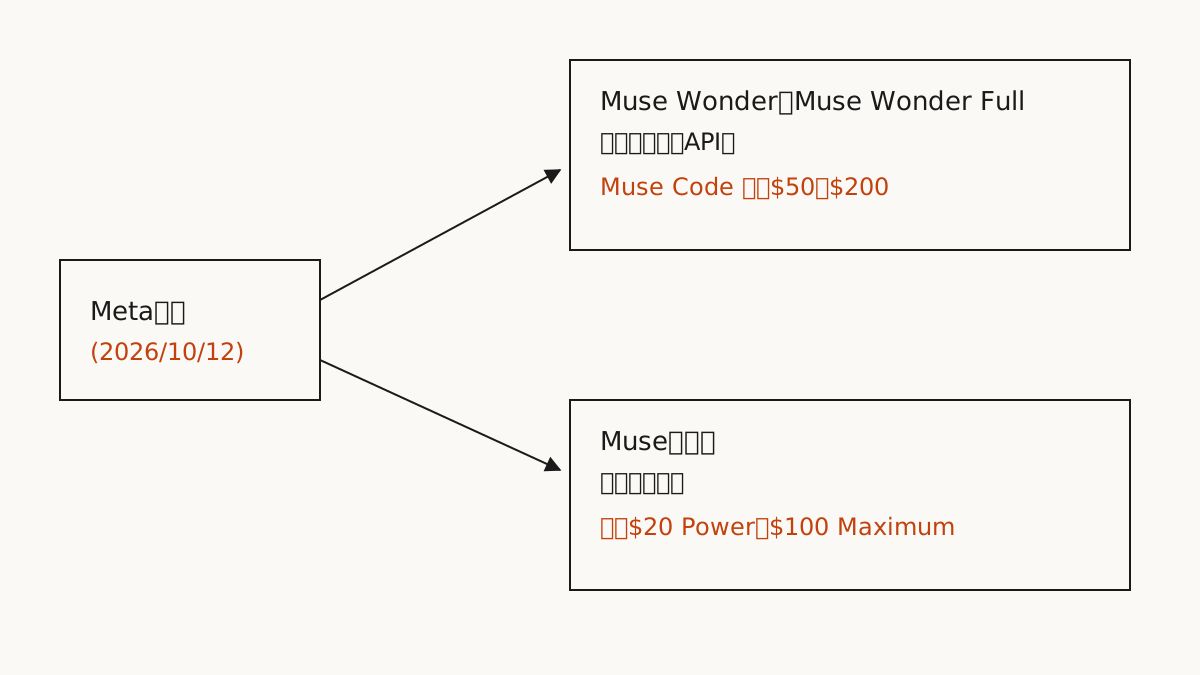
The announcement centers on two main axes. One is for developers to integrate the models into their own agents via API. The other is to gradually roll out Wonder models to users of Meta's personal assistant app, Muse.CNBC's reportdescribes this two-pronged structure as "the latest test of how much users are willing to pay for a paid plan."
Unconfirmed, but the standalone API pricing for Muse Wonder Full (whether standard mode or contributor mode) could not be verified within the scope of the original official announcement that the author was able to access. The figures that could be confirmed are summarized in the next section.
02Pricing and Availability
The confirmed pricing falls into two tracks: one for developers and one for individual users. To use Muse Wonder Full, you need to subscribe to the $50 or $200 monthly plan on Muse Code, the developer-facing product.CNBC's reportreported this pricing.
For individual users, the Muse app takes the approach of first offering the Wonder model to paying subscribers. The app itself costs $20/month (Power) or $100/month (Maximum). This is also sourced fromCNBC's report.
For companies considering business integration, the key question is whether standalone API usage-based billing or a Muse Code subscription better matches their usage volume. Unconfirmed, but as of this writing, a standalone API pricing table for Muse Wonder Full could not be confirmed from public information, and it will be necessary to continue monitoring Meta's officialpricing page.
03Practical Business Use Cases
Given that Muse Wonder is designed for agentic use, its business applications should be narrowed down to tasks that involve processing multiple steps consecutively without human review. In accounting, candidates include tasks with few decision branches and clearly defined procedures, such as reconciling invoices with payment records or performing a first-pass check of monthly trial balances. Unconfirmed, but such reconciliation tasks are commonly cited in reporting as a strong fit for agentic models, and Muse Wonder likely extends along the same lines.
In sales and planning departments, there is potential use in drafting proposal documents or compiling an initial summary of research spanning multiple sources. In HR, drafting initial responses to inquiries is a candidate. In all cases, the design must be built on the premise that final decisions remain with humans, with the agent handling only the initial processing. This design philosophy overlaps with what was covered previously inNext-Generation Internal Workflow Design Incorporating Generative AI.
Given that this announcement is structured around two billing tracks—API usage-based billing and subscription—companies should first determine which billing model fits their usage pattern, before even evaluating performance. The key axis for this decision is whether the task in question is high-volume and run continuously, or called upon only as needed, since this determines which pricing structure is more advantageous. When comparing multiple frontier models, sorting out this usage pattern before evaluating performance is a prerequisite for not wasting time on the comparison process.
04What to Verify on Governance and Data Handling
Before integrating Muse Wonder into business operations, four points must be confirmed: use in training, data storage location, permission design, and audit logging. Since the author has not been able to directly verify the original text of Meta's announcement materials or pricing page, companies considering adoption need to obtain and review Meta's official terms of use and data processing contract terms as primary sources on their own.
Particularly when incorporating agents into tasks handling accounting or HR data, whether the input data is reused for model training depends on the contract terms. Proceeding with adoption without confirming this point risks later governance findings. For governance considerations specific to accounting, seePoints to Sort Out on Governance Before Using AI in Accountingfor further detail.
Permission design must also link the scope of data an agent can access to the permission structure of existing business systems. Audit logging is a prerequisite as well, ensuring it's possible to later trace what the agent executed and on what basis. Neglecting this design leads to the same pattern discussed inWhy Documentation Created to Address Knowledge Silos Goes Unused, where the adopted system itself becomes a formality.
05Next Steps
This week, pick one candidate task within your organization and write out, in numbers, how many times it's processed and how complex the decisions involved are per instance. Not just for Muse Wonder, but for any frontier model adoption decision, the process starts with comparing cost against processing volume.
Specifically, pull from your existing records the monthly processing volume for the target task, the current human working hours involved, and the number of decision-branch patterns. Once you have these three figures, you can estimate whether API usage-based billing or a subscription better fits your organization. Choosing a model without these numbers wastes time comparing pricing plans alone.
The next section outlines concrete steps for carrying out this estimation.
- Pick one candidate task
Choose a task with few decision branches and a clearly defined procedure. Candidates include initial reconciliation in accounting or drafting first-pass responses to inquiries.
- Count monthly processing volume
Using records from the past one to three months, count how many times the target task was processed. Record the count in
Excelor aspreadsheet. - Measure the time per instance
Ask the person responsible for the average working time per instance. Record it in minutes.
- List out decision-branch patterns
Enumerate the points in the process where a human makes a judgment call. Fewer branches make the task more suitable for agent automation.
- Estimate the cost
Using the monthly processing volume and time per instance, calculate the current cost in terms of labor. Compare this against API usage-based billing or subscription fees.
SOURCES
Sources and references
KEY TAKEAWAYS
What to carry into implementation
- Muse Wonder and Muse Wonder Full are agent-focused frontier models announced by Meta on October 12, 2026
- Using Muse Wonder Full requires subscribing to the $50 or $200 monthly plan on the developer-facing Muse Code
- For business adoption, it's necessary to determine whether API usage-based billing or a subscription better fits your organization's usage pattern
- Use in training, data storage location, permissions, and audit logging all need to be confirmed from primary sources before adoption
FAQ
Frequently asked questions
How much would it cost for a Japanese company to use Muse Wonder Full?
The confirmed pricing involves subscribing to the developer-facing Muse Code's $50 or $200 monthly plan. Details on standalone API usage-based pricing could not be confirmed from official information as of this writing, and should be continuously checked on Meta's official pricing page.
Which tasks should be considered first for Muse Wonder adoption?
It makes sense to start with tasks that have few decision branches and clearly defined procedures. Candidates include initial reconciliation in accounting or drafting first-pass responses to inquiries, but the design must be premised on keeping final decisions with humans.