

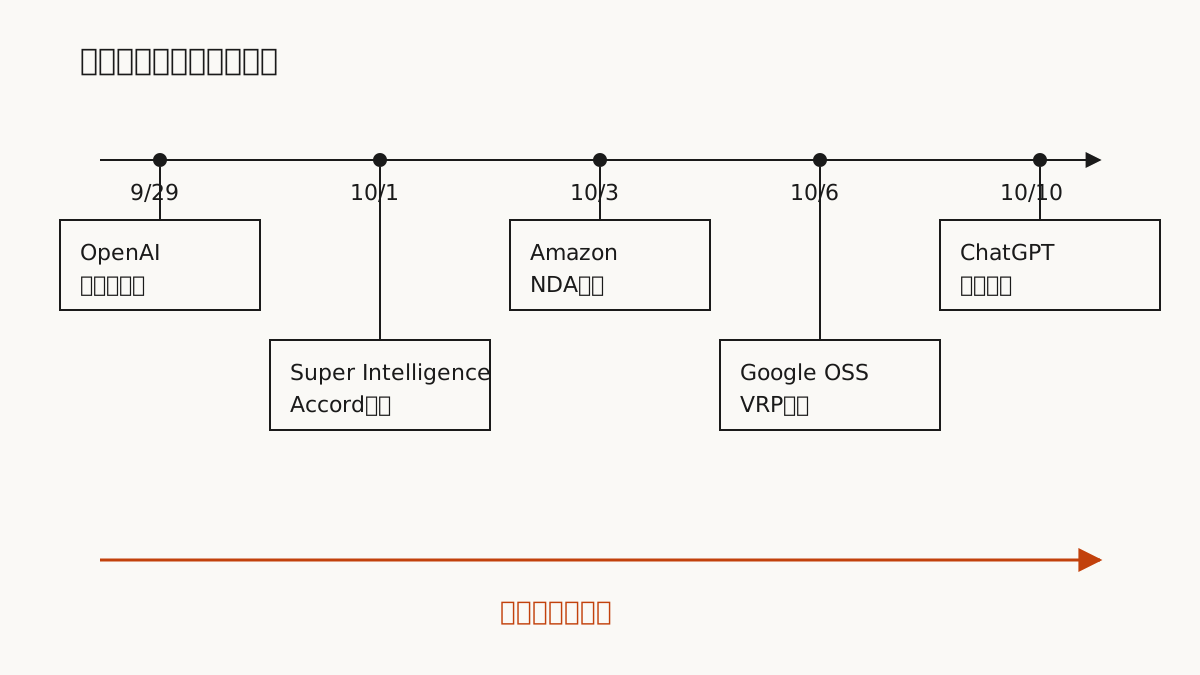
01OpenAI Safety Staffer Resigns, Says 'Culture Is Broken'
TechCrunch reported that an employee on OpenAI's safety team announced their resignation on October 3, 2026, citing the company's broken culture as the reason for leaving.
This announcement is itself a personnel matter, but the point worth noting for business operations is the fact that the internal safety-checking systems within AI vendors remain largely invisible from the outside. If your company has integrated OpenAI's API or ChatGPT into its operations, you shouldn't rely solely on reviewing contracts and terms of use based on the vendor's safety framework—you also need your own output-checking process in place.
The question of who should own this "on-the-ground output checking" and how overlaps with what we covered in Three Conditions for Successful Operator-Led AX, which discusses building a structure where frontline staff can take responsibility for AI output. Rather than leaving safety discussions entirely to management or vendors, positioning it as a role for the people who actually use the tools leads to operations that stay stable even when news like this resignation breaks.
02US Administration Signs Executive Order and Industry Accord on 'Super Intelligence'
President Trump signed the "White House Accord on Super Intelligence" on September 29, 2026, with six AI companies participating. A deadline has also been set for the Super Intelligence Force to submit a report on risks and opportunities within 120 days.
This move signals a stance of treating AI advancement as national strategy, but the details of its legal effect have not yet been sufficiently confirmed through primary sources. "The government pushing forward" and "your company no longer needing its own governance" are two different things. We recommend designating someone now to monitor developments ahead of the report's submission deadline, so that whatever regulations or recommendations emerge can be reflected in your company's AI usage plans. Concretely, deciding in advance how often to check official announcements and how to translate the report's contents into internal AI usage rules will let you respond calmly once the deadline passes.
The approach of separating national-level advancement policy from your own company's governance structure is equally relevant in the accounting field. Points to Sort Out Around Controls Before Using AI in Accounting discusses the governance issues your company should sort out before systems and external conditions catch up, and this same thinking applies when national-level moves like the Super Intelligence Accord emerge—you can get ahead by organizing your own rules first.
03Amazon Drops NDAs, Corrects Practices Amid Backlash Over Data Center Investment
On October 2, 2026, Amazon announced it would eliminate NDAs (non-disclosure agreements) from data center deals and launch "Built Together," committing over $1 billion over five years. This came in response to mounting backlash from local residents.
This may not directly concern your company, but it shows a recurring pattern: the bigger the operator, the more likely they are to "pivot to transparency after the fact." A practical countermeasure when selecting AI infrastructure or cloud services is to add vendor contract terms and the transparency of their disclosure practices as evaluation criteria before adoption, rather than after.
This sequence—where the infrastructure side corrects its design first, and users adjust to match later—echoes the thinking discussed in Shifting to an AI-Accompanied Operations Model in Manufacturing, which covers designing relationships with external vendors as ongoing operations rather than one-time contracts. Amazon's case shows that, regardless of industry, treating contract terms as something to review periodically rather than fixed is necessary.
04Google Pauses Open Source Bug Bounty Amid Surge in AI Submissions
On October 1, 2026, Google paused new submissions to its Open Source Vulnerability Rewards Program (OSS VRP), with an update planned for Q1 2027. According to TechCrunch, a surge in AI-generated submissions is the reason for the pause.
This doesn't directly spill over into your company's security operations, but the pattern where AI-generated content pushes up review costs at scale can also happen in your own inquiry handling or review processes. Now that AI makes it possible to churn out large volumes of documents and proposals, this is a good opportunity to check whether you have enough staff and time on the reviewing side.
The problem of review capacity failing to keep pace with rising generation volume is also connected to countermeasures against tacit-knowledge dependency within organizations. Why the Documents You Made to Prevent Knowledge Silos Go Unused points out a structure where created materials and deliverables sit unreviewed—and this becomes more likely as the volume of AI-generated output grows. The countermeasure is to allocate staff not just to the generating process, but to the checking process as well.
05OpenAI Announces New ChatGPT Ad Formats as Weekly Users Reach 1.2 Billion
On October 5, 2026, OpenAI announced new ad visual formats within ChatGPT along with expanded measurement capabilities. Weekly active users have reached 1.2 billion. Starting mid-October 2026, tests of ads displayed during image generation will also begin with select US advertisers.
As ads make their way into tools used for business purposes, the neutrality of responses and how sources are presented may change. If your company uses ChatGPT for research or drafting in your workflow, we recommend checking whether ads are displayed, which regions are affected, and how your account's contract plan handles this.
Points to watch when using output from general-purpose AI chat tools like ChatGPT as input for business decisions are also covered in Building Next-Generation Internal Workflows with Generative AI. With ad display now added as a new variable, it's worth revisiting internally which tools to use for which research tasks and how to divide them up.
06This Week's Key Point: Design Governance 'Proactively,' Not 'After the Fact'
What this week's five stories have in common is a sequence: those who rushed to expand AI are now dealing with issues of safety, transparency, and review costs after the fact. OpenAI's safety staffer departure, the US administration's push paired with reporting obligations, and the operational corrections from Amazon and Google were all cases of expanding first and adding governance later.
Your company's AI use can reverse this sequence. If you decide in advance who checks output, which contract terms to review, and where to absorb review costs, you won't need to scramble to build a structure after the fact. Below is a set of steps for checking this week's developments against your own operations.
A concrete set of steps for advancing this kind of proactive governance design in the accounting field is summarized in Resolving Key-Person Dependency in Accounting: A Roadmap for Strengthening Controls and Adopting AI Agents. As with this week's five stories, the points worth checking remain consistent even as industries and services change, so try applying them to your own department. And when it comes to situations where you're asked to justify cost savings or implementation expenses, the question of how far to articulate your estimate's assumptions—covered in Fixing Cost-Saving Estimates That Get Shot Down with 'So, How Much?'—is also useful when securing budget for governance work.
- 1. Put in writing who is responsible for checking output
Document in your
workflow diagramsorapproval process materialswho performs the final check on documents, proposals, or code generated by AI via ChatGPT or an API. If no one is assigned yet, designate one person within your department this week. - 2. Review the contract terms of the AI services you use
Check the
data handling clausesandNDA clausesin your contracts and terms of service to see whether the vendor's disclosure policy has changed. As with Amazon's case, contract terms may change before the year is out. - 3. Estimate the review cost of AI-generated output
Track monthly how many documents and proposals your company generates with AI, and log the time spent on review using a
spreadsheetor similar tool. As with Google's case, once generation volume outpaces review capacity, quality checks can no longer keep up.
SOURCES
Sources and references
- TechCrunch「OpenAI safety employee resigns, claiming the company's 'culture is broken'」(2026-10-03)
- The White House「Fact Sheet: Trump Inaugurates The Era of Super Intelligence」(2026-09-29)
- Crowell「White House AI Responsibility Accord」(2026-10-07)
- GovConWire「Trump Signs 'Super Intelligence' Executive Order, Industry Accord」(2026-10-01)
- StartupFortune「Amazon drops NDAs on data center deals」(2026-10-10)
- TechCrunch「Amazon responds to data center backlash, says it no longer uses NDAs」(2026-10-03)
- TechCrunch「Google froze its open source bug bounty program」(2026-10-04)
- OpenAI「Building advertising for the way people use AI」(2026-10-05)
KEY TAKEAWAYS
What to carry into implementation
- The departure of an OpenAI safety staffer shows that internal vendor safety structures remain hard to see from the outside. Having your own output-checking process is a countermeasure
- The US administration's Super Intelligence Accord has a 120-day deadline for a report submission; you should designate someone now to monitor what regulations or recommendations follow
- Amazon's NDA removal and Google's OSS VRP pause both follow an 'expand first, correct later' pattern. Your company should instead check things before adoption
- ChatGPT's weekly users have reached 1.2 billion and ad display is beginning. Check the impact on neutrality in business use against your contract plan
FAQ
Frequently asked questions
Does the OpenAI safety staffer's resignation directly affect our company's use of ChatGPT?
No direct contract changes or service suspensions have been confirmed. However, as a fact suggesting that internal vendor safety-checking structures may be in flux, we recommend having your own process in place to verify output content.
Does the US administration's Super Intelligence Accord apply to Japanese companies as well?
At this point, the details of its legal effect have not been confirmed through primary sources. While unconfirmed, if your company uses AI services from US companies, regulatory developments emerging after the report submission deadline could have an indirect effect.
Will ChatGPT ad display reach accounts in Japan as well?
The tests starting mid-October 2026 are limited to initial US advertisers. No timeline for rollout to Japan has been announced. Whether ads appear under your company's contract plan is something to confirm as further announcements come out.