01What Was Announced
On October 14, 2026, OpenAI published an interview-style article titled "Amp puts AI agents to work beyond code with OpenAI models" featuring Amp CEO Quinn Slack, on its official site.
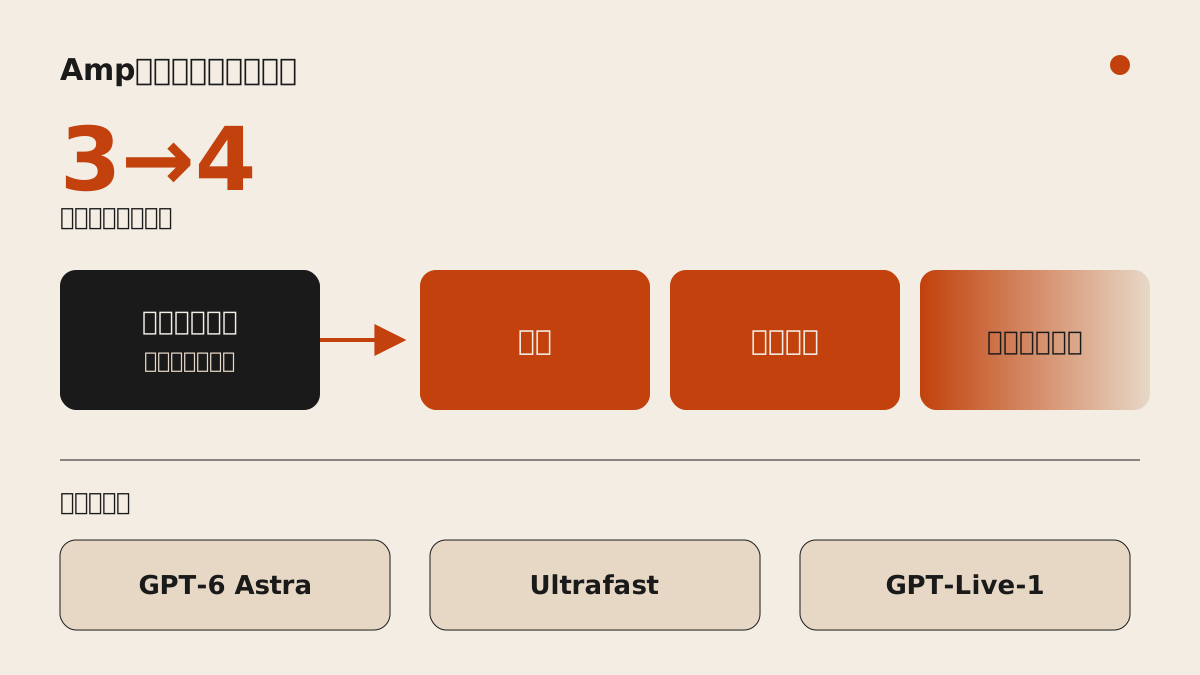
The article explains that while Amp started as a coding assistance agent, it now combines four models and features including GPT-6 Astra, Ultrafast, and GPT-Live-1 to deploy agents into work beyond development teams. The official article does not name specific job functions, and exactly which departments it has expanded into, and to what extent, remains unconfirmed. That said, the interview's context makes clear that agents are beginning to take on multiple roles beyond 'writing' — including 'thinking,' 'speaking,' and 'creating.'
02Pricing and Availability
The official article referenced here is primarily an interview describing the background of the Amp-OpenAI collaboration, and Amp's own pricing structure cannot be confirmed from this source alone. On the other hand, the availability terms for the OpenAI-side models that Amp uses have been publicly disclosed.
GPT-6 Astra is available to Pro, Enterprise, and Business Premium plan users on ChatGPT Work and Codex. Ultrafast mode is also documented officially, positioned as a feature for use cases that prioritize processing speed.
03Where This Fits in Business Operations
What this move suggests is that the 'research, write, and execute' pattern refined through coding agents may apply directly to non-development work as well. This is unconfirmed, but similar agent-based operations could plausibly work for tasks such as reconciling accounting records, drafting sales proposal materials, handling first-line HR inquiries, or conducting market research for planning departments.
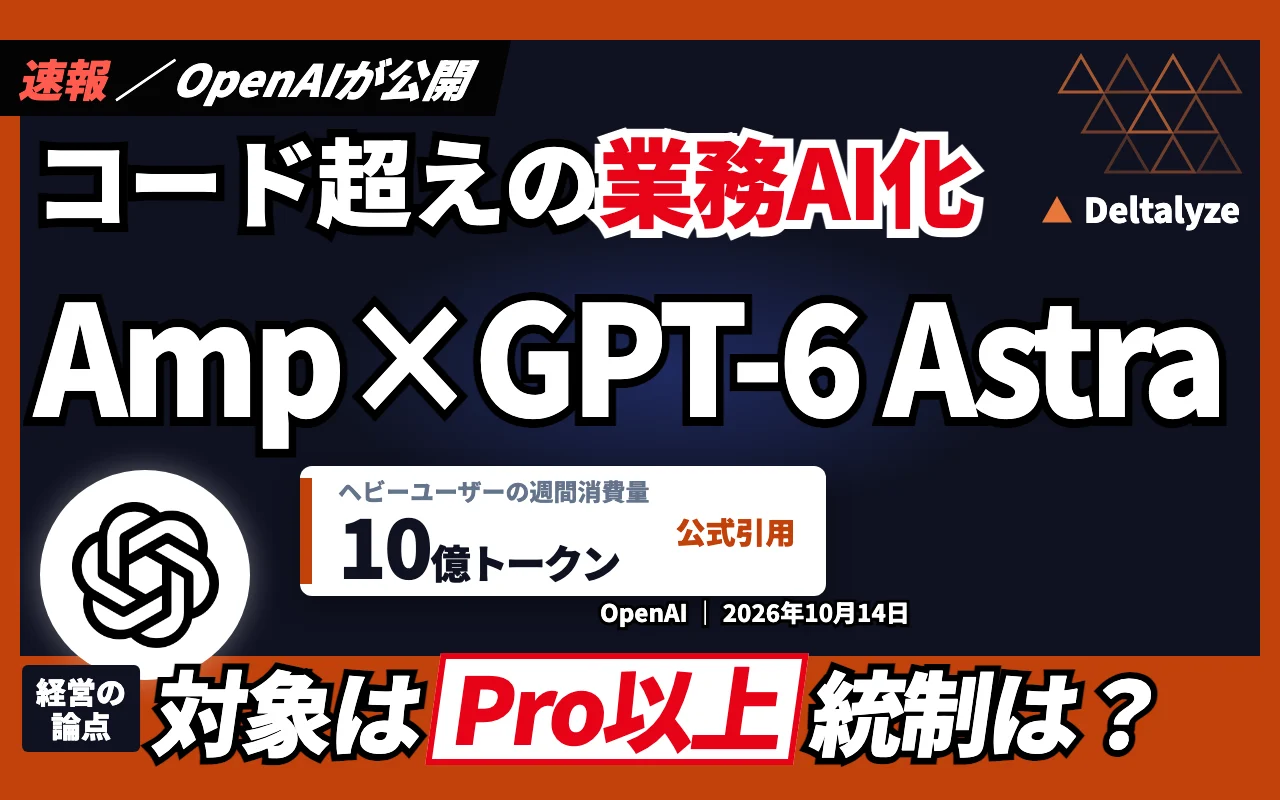
For example, the official article's figure that heavy users consume 1 billion tokens per week (source) shows that operations involving continuously feeding tasks to an agent are genuinely emerging, beyond the scope of a single tool. However, this figure reflects Amp's actual usage and is not itself evidence of expansion into other departments. Each company needs to verify applicability department by department, using its own operational data.
There is an article that frames the question of how to treat these 'always-on agents' as a management decision — arguing that as usage volume and scope grow, the need to predetermine criteria for investment and withdrawal decisions grows larger. Also relevant is the thinking laid out in how to build next-generation internal workflows incorporating generative AI, regarding how agents get embedded into internal workflows over time.
- Accounting: Have an agent handle matching invoices against payment records, with humans checking only the discrepancies
- Sales: Automate drafting proposal outlines from meeting notes, letting reps focus on finishing touches
- HR: Have an agent handle first-line inquiries about internal policies, escalating only exceptions to humans
04What to Verify on Governance and Data Handling
What needs verifying are four points regarding data the agent handles: whether it's used for training, where it's stored, how permissions are designed, and how execution is logged. The official article does not detail Amp's enterprise data handling policy, so you need to individually check the terms of both Amp and OpenAI before adoption.
Particularly when expanding agents beyond development work, the nature of the data handled shifts from source code to customer information or HR data. The scope of execution permissions and what operations get recorded where as an audit log are items that must be confirmed before deployment.
Governance questions like these have already been worked out concretely in the accounting domain. Governance points to sort out before using AI in accounting and Eliminating key-person dependency in accounting: a roadmap for strengthening controls and adopting AI agents cover permission design and audit log thinking in more depth, and serve as useful comparison material when extending a general-purpose agent like Amp into other departments. Similarly, when using agents in HR, you need to decide in advance where to draw the line on whether important human-related decisions — hiring, evaluation, treatment — can be entrusted solely to an agent, and how much must remain subject to final human review.
- 1. Confirm whether data is used for training
Check the terms of use for both Amp and OpenAI to see whether input data is used to retrain the model.
- 2. Confirm where data is stored
Check the provider's documentation for the storage region and server location of processed data.
- 3. Define the scope of execution permissions
Separate which operations the agent can execute independently from which ones require human approval.
- 4. Confirm what the audit log records
Check whether records are kept of who instructed what, when, and what the agent executed.
05The Next Step
What to do this week is to write down one task in your own operations where the 'research, write, execute' pattern applies. This development — the agent's scope expanding beyond coding — gives you material for judging which task to start with.
For the task you write down, compare side by side the time it currently takes versus the scope of checking that would be needed if you handed it to AI. This lets you see both the priority for adoption and the governance checkpoints raised in the previous section at the same time.
Note that the approach to running this kind of inventory with frontline teams in the lead is covered in 3 Conditions for Successful Frontline-Led AX. For how to connect the results of that inventory to business decision-making, see also Deltalyze Platform's Vision: Instantly Connecting Data and Decisions.
You are a business improvement consultant. For the following task, separate out the parts that can be delegated to an AI agent from the parts that require human review.

Task name: [enter task name]
Current steps: [list steps]
Type of data handled: [customer information, internal documents, financial data, etc.]

Output format:
1. Work that can be delegated to the agent (with reasoning)
2. Work that absolutely requires human review (with reasoning)
3. Governance points to check before adoption (from the perspective of permissions, logs, and data storage location)
Replace the content in [ ] with your own company's task details.
SOURCES
Sources and references
KEY TAKEAWAYS
What to carry into implementation
- An October 14, 2026 official article revealed that Amp is expanding agent use beyond coding into other business tasks
- GPT-6 Astra is available to Pro, Enterprise, and Business Premium plan users on ChatGPT Work and Codex
- Expansion beyond development suggests cross-departmental applicability, such as accounting reconciliation or sales document drafting, though actual track record remains unconfirmed
- Before adoption, you need to check four points: training data usage, storage location, execution permissions, and audit logs
FAQ
Frequently asked questions
Can Amp be used as-is by Japanese companies?
The official article has no mention of availability terms for Japan, so this remains unconfirmed. If considering adoption, you need to directly confirm Japanese language support and domestic data storage location with Amp's provider.
Which plan is required to use GPT-6 Astra?
It is available on the Pro, Enterprise, and Business Premium plans for ChatGPT Work and Codex. Availability on free or lower-tier plans is not mentioned in official information.