

01What Was Announced
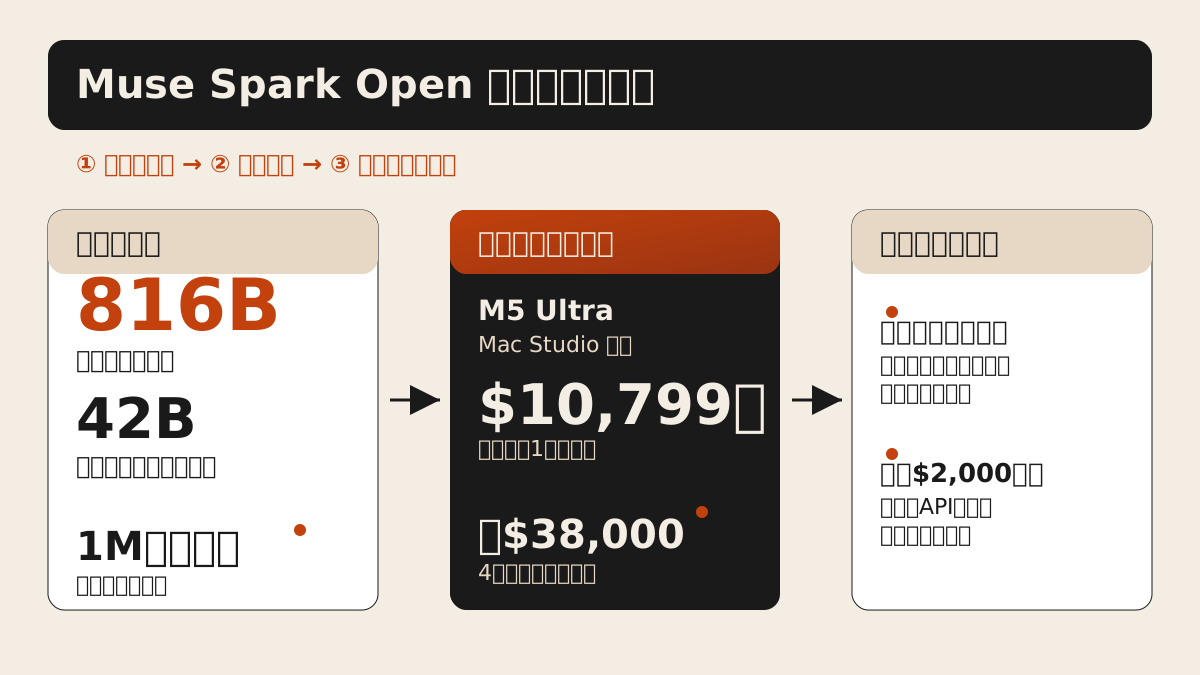
On October 15, 2026, Meta announced an open-weight model called "Muse Spark Open." (Source: Introducing Muse Spark Open) The model has 816B total parameters, with 42B active parameters actually used during processing. Its context window reaches 1M tokens.
TechCrunch reported on this design—running a model of this scale on local Macs rather than the cloud—calling it an "open-weight model that runs on Macs." (Source: Meta launches an open-weight AI model that runs on Macs) According to CNBC, Apple and Meta reportedly collaborated to get the model running on Mac hardware. (Source: Apple and Meta team up to make Muse AI model run on Mac computers) The design itself—processing completed entirely on-device without routing through cloud servers—carries real significance for businesses wary of sending data externally.
The core of this announcement is that the option of a large-scale model independent of cloud APIs has arrived within reach of companies' own hardware.
02Pricing and Availability
Muse Spark Open is released under a proprietary license called the "Muse Model License," with a pricing structure entirely separate from cloud APIs. (Source: Meta ships Muse Spark Open, its answer to China's best open-weight models) The license terms vary depending on usage scale and deployment format, meaning you can't simply compare it to pay-as-you-go API pricing. Running the model also requires a separate hardware investment, so you need to budget implementation costs on two fronts: licensing terms and hardware investment.
According to Meta's announcement, the recommended setup is two Mac Studios equipped with M5 Ultra chips (each with 512GB of unified memory), run together for roughly 1TB of combined memory. (Source: Introducing Muse Spark Open) According to CNBC, the minimum configuration—a single Mac Studio with M5 Ultra and 256GB of memory—starts at $10,799. (Source: Apple and Meta team up to make Muse AI model run on Mac computers) An alternative configuration combining four 256GB units can also run the model, with Engadget reporting a total cost of roughly $38,000. (Source: Meta built a huge open-weight AI model for Macs, but you'll need 1TB of RAM to run it)
Licensing terms also need review. Companies with annual revenue exceeding $20 million that want to offer this model as an API to third parties must notify Meta and enter a separate agreement. (Source: Meta ships Muse Spark Open) Internal use and embedding the model into your own products are reportedly exempt from this requirement. Whether you're building it into a service for external sale or keeping it in-house changes how the license applies—a distinction worth noting.
Comparing the two-unit and four-unit setups: both reach roughly 1TB of total memory, but the two-unit configuration uses the newer-generation M5 Ultra chip, making each unit more expensive. The four-unit approach keeps total cost down by adding more units of an older-generation configuration. The choice comes down to a straightforward trade-off: prioritize processing speed, or minimize upfront investment. What would be a pay-as-you-go expense under a cloud API becomes a fixed cost paid upfront when running the model yourself—a factor that changes how you need to plan your budget.
03Where It Fits in Business Operations
The biggest advantage is the ability to use a large-scale model without sending confidential data externally. In accounting reconciliation work, it may be possible to process sensitive internal documents—contracts, invoices—without passing them through a cloud API. This is unconfirmed, but given the 1M-token context window, there's likely room to feed in large volumes of journal entries and supporting documents at closing time to help surface discrepancies. Accounting and finance are areas well positioned to benefit from this kind of self-hosted model.
In sales, a likely use case is drafting proposals or searching through past deal records. Being able to process proposal materials containing customer information without sending them to the cloud is likely to be valued from an information-management standpoint. Similarly, in HR inquiry handling or planning department research, the ability to handle internal documents without external transmission could be a key motivator for adoption. Manufacturing also handles information that's hard to send externally, like drawings and quality data, and there's room to combine this with the kind of hands-on operational structure discussed in The Shift Toward AI-Assisted Operating Models in Manufacturing.
That said, all of this assumes running the hardware in-house. Unlike pay-as-you-go cloud APIs, hardware costs arrive upfront as a capital expense—something to keep in mind when weighing where this fits into your operations. For broader design considerations around embedding generative AI into internal workflows, see Building Next-Generation Internal Workflows with Generative AI. For conditions around driving front-line-led AX initiatives, Three Conditions for Successful Front-Line-Led AX is also worth reviewing.
When considering a self-hosted model, it's also worth thinking about how the processed data feeds into actual decision-making, rather than just piling up. For ideas on connecting data directly to decision-making rather than letting it sit idle, see How the Deltalyze Platform Connects Data to Decisions in Real Time. Given the hardware investment involved, it's also important—for the sake of ROI—to design for use across multiple departments rather than a single isolated efficiency gain.
- Accounting: reconciling and verifying contracts and invoices without external transmission (unconfirmed, but plausible)
- Sales: drafting proposal materials containing customer information without sending them to the cloud
- HR, planning: handling inquiries and research preparation that rely solely on internal documents
04What to Verify for Governance and Data Handling
Precisely because you're running this yourself, the governance design is your own responsibility to build. With a cloud API, you can rely on checking the vendor's data-use policy and storage location. Running the model on a Mac in-house means you have to build your own systems for storing input data, managing access permissions, and logging processing activity.
A key thing to verify is keeping records of who entered which documents into the model. If you're handling internal documents, without an audit-logging mechanism, you have no way to trace what was processed after the fact. For governance considerations before using AI in accounting, see What to Sort Out on Governance Before Using AI in Accounting. Governance design for embedding AI into processes that depend heavily on specific individuals is covered in Reducing Key-Person Dependency in Accounting: A Roadmap for Strengthening Controls and Adopting AI Agents.
Another point is licensing. Internal use is exempt from the licensing requirement, but if you embed the model in your own product for customers, or offer it as an API to third parties while exceeding $20 million in annual revenue, you need to confirm in advance that notification to and an agreement with Meta is required.
Beyond that, getting a self-hosted AI model to actually stick in day-to-day operations may require more than simply writing up a usage guide. The way documentation created to reduce key-person dependency tends to fall out of use over time is covered in Why Documentation Created to Reduce Key-Person Dependency Stops Getting Used, and that same dynamic applies here, especially given the hardware investment involved. It's not enough to set operating rules and stop there—you need to build them into who checks what as part of actual practice.
If you're running AI in-house, regulatory developments abroad are also worth watching. On the trend toward imposing governance on AI decision-making in HR, the points raised in California Bans AI-Only Termination Decisions: Governance Japanese Companies Should Adopt Early for HR AI apply directly to governance design when using a self-hosted model for HR work. And how an AI vendor itself handles safety is a useful lens, covered in OpenAI Delays Its 2026 IPO: What a Safety-Driven Postponement Signals to Adopting Companies—a useful reference point when deciding whether to switch to self-hosted operation.
05What to Do Next
What you can do this week is identify the data at your company that "can't go to the cloud." The value of a self-hosted model like Muse Spark Open lies precisely in operations where a cloud API isn't an option. The next step is to pinpoint target workflows and estimate whether the hardware investment pays off.
A common pitfall in these estimates is looking only at hardware cost and jumping to a snap judgment—"too expensive for the savings" or "cheap enough, let's go." For the typical pattern where cost-savings estimates fall apart when explained to leadership, see How to Fix Cost-Savings Estimates That Get Shot Down by "So, How Much?", which applies directly to explaining a hardware investment like this one. Whether you can present upfront investment and savings on the same footing is often what determines whether internal approval goes through.
Concretely, the steps below can help you organize the decision-making material for your own company.
- Inventory target workflows
List, by department, the workflows that handle documents that can't leave the company (e.g., accounting document verification, legal contract review).
- Estimate data volume
Check whether the volume of documents you want to process in a single run fits within the 1M-token context window.
- Estimate hardware investment
Using the benchmarks of $10,799+ for the minimum configuration and roughly $38,000 for a four-unit setup, estimate the number of units and total cost needed for your processing volume.
- Confirm the licensing category
Clarify whether use will be strictly internal or whether you plan to offer it as a customer-facing API down the line, and check whether the $20 million revenue threshold applies.
- Design permissions and audit logging
Build a system that records who entered which documents before going live in production.
You are responsible for process improvement in [department name, e.g., Accounting]. Based on the conditions below, list five candidate use cases for a self-hosted AI model like Muse Spark Open.

Conditions:
- Focus on tasks that [department name] handles on a routine basis
- Prioritize tasks involving confidential information that cannot be sent externally (e.g., contracts, performance reviews, unreleased financial figures)
- Estimate the volume of documents (pages or items) to be fed in per processing run, for each task
- Specify the expected type of processing (reconciliation, summarization, search, drafting, etc.)

Output format: Present as a table with columns for task name, target data, processing type, and estimated monthly volume.
Replace the department name and examples of confidential information with specifics from your own organization. Use the resulting candidates to move into estimating whether the hardware investment is worthwhile.
SOURCES
Sources and references
- Meta AI Research「Introducing Muse Spark Open」(2026-10-15)
- TechCrunch「Meta launches an open-weight AI model that runs on Macs」(2026-10-15)
- CNBC「Apple and Meta team up to make Muse AI model run on Mac computers」(2026-10-15)
- Engadget「Meta built a huge open-weight AI model for Macs, but you'll need 1TB of RAM to run it」(2026-10-15)
- The New Stack「Meta ships Muse Spark Open, its answer to China's best open-weight models」(2026-10-15)
KEY TAKEAWAYS
What to carry into implementation
- Muse Spark Open is an open-weight model with 816B total parameters, 42B active parameters, and a 1M-token context window, designed to run on Mac hardware
- The recommended setup is two Mac Studios with M5 Ultra chips, totaling roughly 1TB of memory; the minimum configuration starts at $10,799, with a four-unit setup costing roughly $38,000
- Companies with annual revenue exceeding $20 million that offer the model as a third-party API must notify Meta and sign a separate agreement; internal use is exempt
- Before adoption, companies must identify workflows handling data that can't go to the cloud, and design input logging and permission management
FAQ
Frequently asked questions
Is Muse Spark Open free to use?
The model itself is released as open weights, but running it requires substantial hardware. Even the minimum configuration starts at $10,799. (Source: Apple and Meta team up to make Muse AI model run on Mac computers)
Can it run on a Windows PC?
Both the announcement and press coverage assume operation on Mac Studio. This is unconfirmed, but given the scale of unified memory and the overall design, replicating an equivalent setup on another OS is likely difficult.
What happens if we embed it in our own product for customers?
Internal use and embedding into your own products are exempt from the licensing requirement, but companies with annual revenue exceeding $20 million that offer it as an API to third parties must notify Meta and enter a separate agreement. (Source: Meta ships Muse Spark Open)